

A Battery Energy Storage System (BESS) stores and releases energy through electrochemical processes, enabling flexible energy management across time and space. With the increasing adoption of renewable energy and distributed grids, the BESS market is expanding rapidly. According to Grand View Research (2024), the global BESS market reached approximately $7.97 billion in 2023 and is projected to exceed $58 billion by 2030. This growth underscores the rising demand for reliable and flexible energy storage solutions in modern power systems.
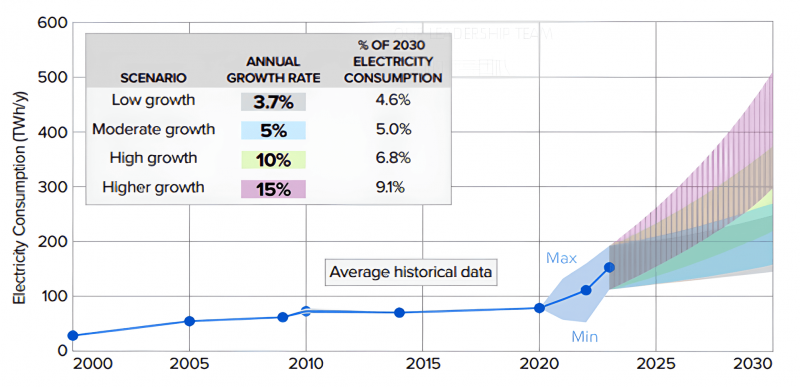
Battery Report:Data centre power consumption is expected to triple by 2030 as a proportion of total US power demand – and could be even greater, as shown in the graph below
Battery energy storage system components
-
Battery Modules: The core of the system, responsible for storing electrical energy. The chemistry of the battery cells determines efficiency, safety, and lifespan. Thanks to technological advancements, the cost of large-scale lithium-ion systems has dropped to around $165 per kWh by 2024, nearly 40% lower than the previous year, reflecting improvements in battery technology and modular system integration.
-
Battery Management System (BMS): Monitors battery parameters—temperature, voltage, and current—in real time to prevent overcharging or over-discharging, ensuring safety and longevity.
-
Power Conversion System (PCS): Converts energy between AC and DC, serving as the critical interface between the BESS and the grid.
-
Energy Management System (EMS): Coordinates operations between the storage system and external grids, enabling intelligent energy dispatch and analytics.
-
Thermal Management and Safety System: Maintains batteries within a safe temperature range via air or liquid cooling, preventing thermal runaway.
-
Cabinet or Container Enclosure: Provides protection, standardized interfaces, and rapid deployment capability to ensure stable operation across various environments.
Types of BESS Systems
Lithium-ion Battery BESS
Lithium-ion batteries remain the most widely used technology due to their high energy density, long cycle life, and efficiency above 90%. In fact, more than 98% of the global newly deployed BESS capacity in 2024 will use lithium-ion technology. Despite the emergence of alternatives like sodium-ion and flow batteries, lithium-ion remains dominant.
LFP (Lithium Iron Phosphate) BESS
LFP is the safest and most stable lithium chemistry. It offers excellent thermal stability and high cycle life, ideal for stationary, long-duration energy storage. Compared to conventional lithium batteries, LFP has better high-temperature performance and lower failure rates, making it the mainstream choice for commercial and industrial applications.
Lead-acid BESS
A mature and cost-effective solution, suitable for applications with lower energy density requirements, such as backup power or small off-grid systems. Although reliable and inexpensive, lead-acid batteries have limited cycle life and are gradually being replaced by lithium-based solutions.
Sodium-ion BESS
An emerging technology with good low-temperature performance and cost advantages. Sodium is abundant and inexpensive, making sodium-ion batteries a promising alternative for mid- to large-scale stationary energy projects. This technology is currently in rapid commercialization.
Flow Battery BESS
Flow batteries store energy via liquid electrolytes, offering scalable capacity, long lifespan, and high cycle capability. They are ideal for long-duration storage, including renewable energy integration and peak-shaving applications.
Key Features of Modern BESS Systems
-
High Energy Density & Efficiency: New-generation cells enable compact systems with 92–95% conversion efficiency.
-
Modular & Scalable: Standardized design allows rapid deployment from hundreds of kW to hundreds of MW.
-
Smart Control & Remote Monitoring: Integrated EMS and cloud platforms provide intelligent scheduling, predictive analytics, and alerts.
-
Millisecond-level Response: Ensures uninterrupted power during grid fluctuations, load changes, or emergency switching.
-
Enhanced Safety: Multi-layer protection, including cell-level safeguards, thermal redundancy, and integrated fire suppression, ensures lifecycle safety.
-
Green & Sustainable: Seamlessly integrates with solar and wind systems to support low-carbon energy solutions.
Benefits of BESS
-
Reduce Peak Electricity Costs: Optimizes energy expenses through peak shaving and load leveling.
-
Enhance Energy Independence: Maintains critical operations during grid instability or off-grid conditions.
-
Support Renewable Transition: Improves utilization of green energy while reducing carbon emissions.
-
Smart Operation & Maintenance: Real-time monitoring enhances reliability and extends battery life.
-
High Operational Stability: Ensures continuous power delivery to critical loads during voltage fluctuations or unexpected outages.
Attom BESS System Support
Explore Attom BESS Solutions, designed for high reliability, intelligent energy management, and energy optimization. Our systems integrate seamlessly into various infrastructures, delivering continuous power, lower carbon emissions, and maximized energy efficiency. Partner with us to build a flexible, future-ready energy ecosystem.
Leave A Comment
You must be logged in to post a comment.