

As data centers evolve to support AI, machine learning, and high-performance computing (HPC) workloads, traditional air-cooling systems are reaching their physical and efficiency limits.
Direct-to-Chip (D2C) liquid cooling has emerged as a powerful alternative, offering precise heat management, higher rack density, and significant energy savings — all while supporting sustainable operation goals.
How Does Direct-to-Chip Cooling Work?
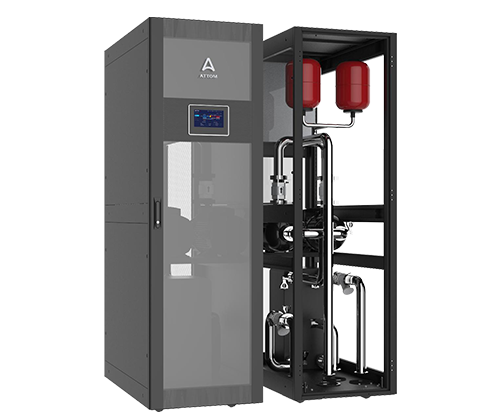
Direct-to-Chip (D2C) cooling works by circulating a liquid coolant through a closed-loop system that interfaces directly with the hottest components — CPUs, GPUs, and memory modules.
Cold plates are mounted directly on these chips, transferring heat to the liquid through thermal conduction. The heated liquid then flows to a Coolant Distribution Unit (CDU), where it releases the heat through a heat exchanger before being recirculated.
This targeted, closed-loop method eliminates many inefficiencies of air cooling and provides stable temperature control even under demanding workloads.
Components Involved in Direct-to-Chip Cooling Systems
Cold Plates: Custom-designed plates that attach directly to chip surfaces, ensuring efficient heat transfer.
Manifolds and Tubing: Channels that distribute coolant evenly across multiple servers or racks.
Coolant Distribution Unit (CDU): Regulates pressure, temperature, and flow rate; connects server loops to facility water systems.
Heat Exchanger: Transfers heat to the facility’s secondary loop or outdoor chiller.
Pumps and Sensors: Maintain consistent circulation and monitor temperature, flow, and leak detection for reliability and safety.
Together, these elements form a modular, efficient system that delivers precision cooling with minimal maintenance overhead.
What Are the Different Types of Direct Liquid Cooling Technology?
Direct liquid cooling generally falls into two categories — single-phase and two-phase — depending on how the coolant interacts with heat.
Single-Phase Direct-to-Chip Cooling
In single-phase systems, the coolant remains in liquid form throughout the entire loop. It absorbs heat from components, rises slightly in temperature, and releases that heat through the heat exchanger.
This method is simple, stable, and widely adopted. It uses water or a water-glycol mixture and works well with standard components, making it suitable for both new builds and retrofits in existing facilities.
Two-Phase Direct-to-Chip Cooling
Two-phase systems use a dielectric fluid that changes phase from liquid to vapor when heated. The vapor then condenses back into liquid in the heat exchanger, creating a self-regulating thermal process.
Because phase change absorbs large amounts of heat, these systems deliver higher cooling density and lower pumping power, ideal for AI training clusters, supercomputing, and dense HPC deployments.
Advantages of Direct-to-Chip Liquid Cooling
Direct-to-Chip cooling offers multiple technical, operational, and sustainability advantages that make it one of the most compelling solutions in modern data centers:
Superior Cooling Efficiency: By removing heat at the source, D2C cooling can maintain chip temperatures within a few degrees of the coolant temperature, often achieving thermal efficiency up to 95%. This precision helps sustain consistent performance during peak workloads.
Significant Energy Savings: D2C systems reduce or eliminate the need for air conditioning and fan-based cooling, cutting total facility energy use by 30–40%. This directly improves PUE (Power Usage Effectiveness) metrics.
Higher Density and Scalability: Because cooling capacity scales with coolant flow rather than airflow, operators can deploy higher-density racks (50–100 kW+) without thermal risk.
Reduced Noise and Improved Environment: With fewer fans and lower airflow demands, the data hall becomes quieter, cleaner, and easier to maintain.
Longer Hardware Lifespan: Consistent, low operating temperatures reduce thermal stress, extending component lifespan and reducing unplanned downtime.
Operational Flexibility: D2C supports hot water cooling, meaning facilities can use inlet temperatures up to 45°C, simplifying chiller requirements and enabling free cooling in many climates.
Sustainability and Heat Reuse: The warm water output can be reused for district heating, absorption chillers, or industrial processes, aligning with corporate ESG goals and energy reuse initiatives.
In short, D2C cooling is not just about efficiency — it’s about building future-ready, high-density data centers that meet both performance and sustainability demands.
Considerations for Implementing a Direct Liquid Cooling System
While D2C cooling offers remarkable benefits, proper planning and system integration are essential for long-term success. Operators should carefully evaluate the following:
Infrastructure Compatibility:
Existing racks and servers may need modification or replacement to accommodate cold plates and coolant loops. Early design coordination with OEMs ensures smooth integration.
Facility Water Loop Design:
The secondary loop must maintain proper flow, temperature, and filtration levels to avoid thermal bottlenecks. In some cases, CDUs and rear-door heat exchangers can be added to bridge facility water with IT cooling loops.
Maintenance and Serviceability:
Regular inspection of coolant quality, pressure, and connector seals is essential. Training maintenance staff in liquid handling and leak management is key to safe operation.
Redundancy and Reliability:
Systems should include dual pumps, redundant sensors, and backup CDUs to ensure uptime. Integrated monitoring platforms can automate fault detection and alerting.
Upfront Investment vs. Long-Term Savings:
While initial deployment costs are higher than air-based systems, energy efficiency, higher density, and longer equipment life typically deliver ROI within 2–4 years.
Vendor Ecosystem and Support:
Choosing an experienced liquid cooling provider ensures quality, compatibility, and future scalability. Collaboration between cooling vendors, IT hardware OEMs, and facility operators is crucial.
A well-planned D2C deployment can seamlessly fit into both existing and new data centers, delivering measurable operational, financial, and sustainability benefits.
Is Direct-to-Chip Better than Immersion Cooling?
Both Direct-to-Chip and Immersion Cooling are advanced liquid cooling methods, but they serve different objectives:
Direct-to-Chip Cooling is cleaner, modular, and ideal for gradual upgrades or hybrid deployments. It integrates with existing racks and data center layouts, minimizing disruption.
Immersion Cooling submerges entire servers in a dielectric fluid, offering even greater heat removal but requiring specialized enclosures and maintenance procedures.
In practice, D2C is preferred for enterprise or colocation facilities seeking efficiency without redesigning their infrastructure, while immersion cooling is chosen for hyperscale or HPC environments pushing extreme power densities.
Leave A Comment
You must be logged in to post a comment.