

A New Era of Exploding Data
The arrival of AI and 5G has once again amplified the importance of data centers. Training large models requires massive computing power, while 5G demands millisecond-level responsiveness. From smart healthcare and autonomous driving to streaming entertainment, virtually every emerging application is powered by data centers.
The problem is that traditional data center architectures are increasingly unable to keep up. Energy consumption continues to rise, latency is hard to reduce, and scalability often lags behind business growth. Without change, data centers themselves may become the bottleneck.
The New Demands of AI
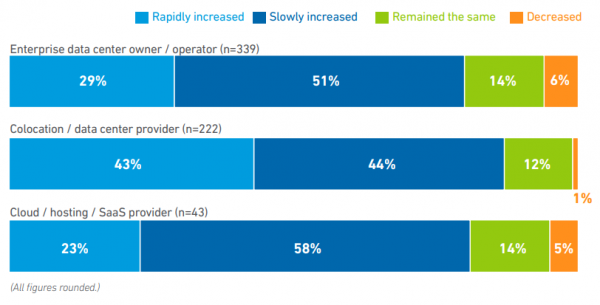
The rapid rise of AI is first testing data centers on the front of high-density computing. According to the Uptime Institute 2024 Global Data Center Survey, nearly two-thirds of data centers have seen rack power density increase over the past three years. This is driven largely by rising chip power—even without accelerators—making air cooling insufficient.
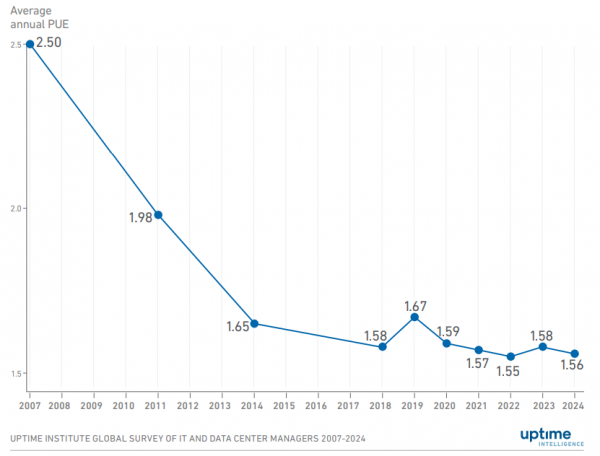
Liquid cooling, rear-door heat exchangers, and immersion technologies have entered the stage. In theory, they can drive PUE as low as 1.2 or below. Yet in practice, average PUE has remained around 1.55 in recent years. The main reason: 47% of global facilities are aging, and large-scale retrofits are costly and disruptive, leaving operators hesitant. Hybrid cooling approaches—rear-door exchangers, localized cooling—are now mainstream stopgaps, but as rack densities keep climbing, more efficient and sustainable facilities are already in preparation, and PUE will gradually fall in the years ahead.
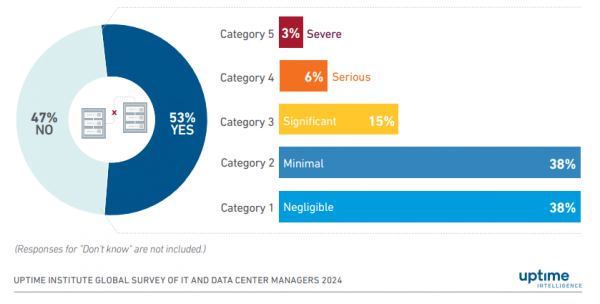
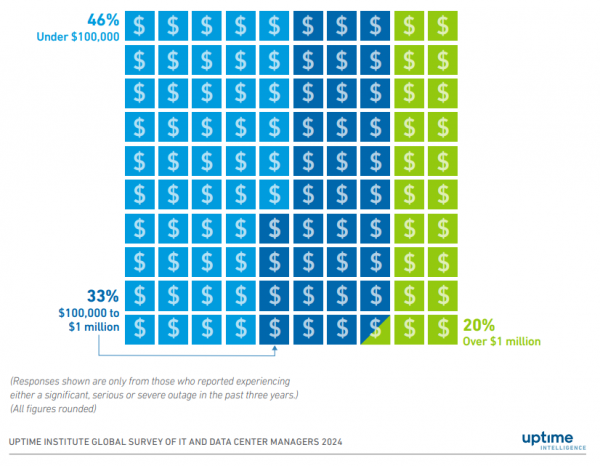
AI also raises the stakes for reliability. Training jobs can run uninterrupted for days or even weeks, and downtime can result in severe losses. The Uptime Institute 2024 survey shows that outage frequency and severity are trending down thanks to stronger reliability practices. But costs remain high: one in five outages still results in losses over $1 million—including both direct and reputational costs.
Finally, AI intensifies network pressure. Training and inference involve massive data flows, demanding greater bandwidth and lower latency. Otherwise, even the strongest compute resources are bottlenecked. AI has shifted the bar: data centers must not only “compute,” but also compute fast, reliably, and sustainably.
The New Demands of 5G
If AI forces data centers to become more efficient inside, 5G pushes them to be more flexible outside.
The hallmark of 5G is low latency, meaning many workloads must be processed closer to the user rather than in central facilities. This is why edge computing is on the rise. Unlike traditional data centers, edge nodes must deploy quickly and fit into distributed environments. Modular, prefabricated data centers are well suited for this need—they can be delivered in weeks and align naturally with 5G base station rollouts.
5G also brings traffic volatility. Peak hours demand rapid capacity expansion, while off-peak periods require avoiding wasted resources. Traditional, rigid data centers struggle to meet this elastic requirement.
The Synergy of AI and 5G
AI and 5G are not simply parallel trends—they reinforce each other.
AI inference is moving outward, running at edge nodes where 5G’s low latency enables true real-time response. For use cases like autonomous driving, smart factories, and smart cities, this convergence is indispensable.
Meanwhile, core data centers still handle large-scale training and centralized computation. As a result, data center architecture is stretching in two directions: ultra-large compute at the core and flexible nodes at the edge. Energy efficiency and sustainability are the shared demands connecting both ends.
Key Features of Next-Generation Data Centers
Looking ahead, data centers must incorporate several essential features:
-
Modularity & Prefabrication: Rapid deployment and flexible scaling to keep pace with business demands.
-
Liquid Cooling & Advanced Thermal Management: To support high-power chips and dense racks while boosting efficiency.
-
Intelligent Operations & Maintenance: Automation and predictive maintenance to minimize downtime.
-
Green Energy Integration: Leveraging renewables and storage to cut carbon emissions and meet ESG goals.
These are not “value-adds”—they are must-haves.
Conclusion: Infrastructure for the Future
The convergence of AI and 5G is transforming data centers from traditional server rooms into distributed, intelligent infrastructure. They must support compute-intensive training while enabling low-latency edge applications. They must deliver higher efficiency while ensuring long-term reliability.
At Attom, we believe the keywords for the next generation of data centers are modular, liquid-cooled, and intelligent. We are committed to working with our customers to build more efficient, greener, and more flexible digital foundations.
👉 Contact us to explore future-ready data center architectures.
Leave A Comment
You must be logged in to post a comment.