

Liquid cooling is becoming a core infrastructure for next-generation high-performance data centers. With AI model training, cloud computing, and high-performance computing (HPC) driving increasing compute density, data centers now demand unprecedented thermal control precision and energy efficiency. Compared to air-based cooling, liquid cooling uses the high heat capacity and thermal conductivity of coolant to efficiently transfer heat directly from the source, achieving lower PUE, more stable operating temperatures, and more compact compute unit designs.
RDHX (Rear Door Heat Exchanger)
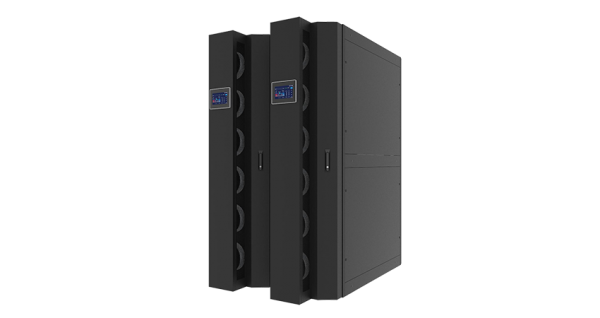
RDHX:Supports both Chilled Water (CW) and Direct Expansion (DX) cooling systems.
RDHX is a rack-level liquid cooling solution that installs a liquid heat exchanger on the rear door of a server cabinet. Exhaust heat is removed via chilled water circulation. This solution is easy to deploy, suitable for medium-density environments and retrofit projects. RDHX provides localized liquid cooling without modifying the internal rack structure, reducing air conditioning load and energy consumption while supporting incremental upgrades without affecting existing equipment operations.
D2C (Direct-to-Chip) Cooling
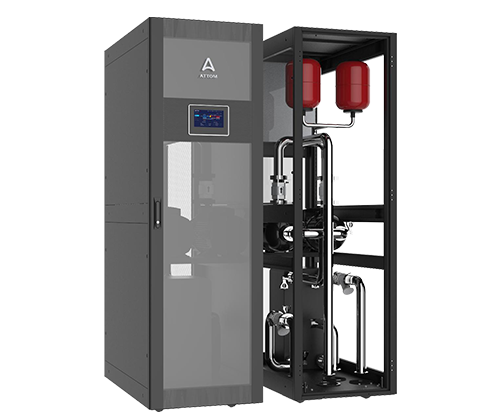
D2C Liquid Cooling:Up to 50kW cooling capacity in 6U space saving dimension.
D2C cooling delivers coolant directly to CPUs, GPUs, or other high-heat-density chips via cold plates for precise thermal conduction. This method provides extremely high cooling efficiency, capable of handling HPC, AI training, and high-density cloud computing nodes under sustained full load. D2C systems typically include modular cold plates, liquid distribution networks, and temperature sensors that adjust flow in real time to ensure temperature balance and equipment stability. Compared to rack-level liquid cooling, D2C is better suited for compute-intensive applications, allowing higher compute density per unit area.
Immersion Cooling
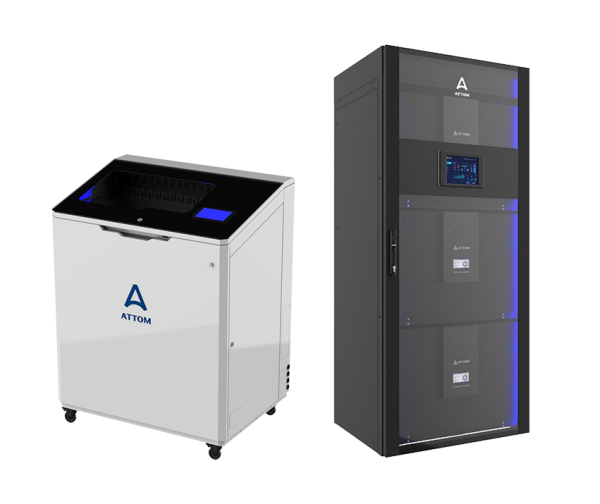
ATTOM OceanCool:Liquid cooling cabinet + CDU distribution unit integrated as one for plug and play
Immersion cooling submerges entire servers or compute nodes in dielectric coolant to remove heat directly. Immersion systems can be single-phase or dual-phase: single-phase cooling circulates the heated liquid to a heat exchanger, while dual-phase cooling uses liquid evaporation for heat absorption and condensation for heat release. This approach excels in ultra-high-density HPC clusters, reducing fan energy consumption and data center noise while minimizing hotspots. Immersion cooling also enables more compact rack layouts and is a key cooling solution for future supercomputing centers and AI clusters.
Liquid-to-Air Hybrid Cooling
Liquid-to-air hybrid cooling combines liquid and air heat transfer methods. The liquid absorbs heat from devices and then transfers it to the air via a heat exchanger. This solution is widely used in medium-density data centers or edge computing environments. It provides good compatibility with existing air-cooled infrastructure, enabling smooth upgrades. Liquid-to-air hybrid systems ensure effective heat removal while offering flexible deployment options and moderate energy savings, making them ideal for transitional or retrofit data centers.
Commercial Benefits of Liquid Cooling
Liquid cooling not only improves heat dissipation but also delivers significant commercial value. By reducing cooling energy consumption, liquid cooling lowers PUE and operational costs. Stable thermal conditions extend the lifespan of servers, GPUs, and other equipment, reduce fan and mechanical maintenance, and minimize downtime risks. Liquid cooling allows higher density deployments, increasing compute output per unit area, which benefits HPC, AI model training, and cloud services economically. Additionally, liquid cooling supports green data center initiatives, reduces carbon emissions, and aligns with ESG and sustainability goals. Despite higher initial investment, energy savings, reduced maintenance, and increased compute density usually yield ROI within 2–3 years.
Support for Liquid Cooling in ATTOM
Attom provides comprehensive liquid cooling support to help clients achieve high efficiency and stable operation across various data center scenarios.
- Modular Design & Flexible Deployment
Provides modular liquid cooling components for different rack sizes and power densities.
Supports rapid deployment and expansion of RDHX, D2C, immersion, and liquid-to-air hybrid cooling. - Hardware Compatibility & Custom Solutions
Offers compatibility verification and custom cold plate solutions for servers, GPUs, and accelerator cards.
Adapts to existing infrastructure to reduce retrofit risks. - Operations & Lifecycle Management
Provides long-term operational guidance and technical support to ensure stable system operation.
Includes leak protection, coolant management, and inspection strategies to maintain a safe and reliable liquid cooling environment.
Contact our cooling experts to explore customized liquid cooling solutions.
Leave A Comment
You must be logged in to post a comment.