Definition
AI Cooling refers to the cooling technologies and thermal management strategies used to remove heat generated by AI servers, GPUs, accelerators, and other high-density computing equipment.
Because AI workloads can create substantially higher power and heat density than conventional IT workloads, AI cooling often requires more advanced cooling architectures than traditional room-level air cooling.
AI cooling may include air cooling, liquid cooling, direct-to-chip cooling, rear door heat exchangers, immersion cooling, and hybrid cooling systems.
Why AI Cooling Matters
AI infrastructure concentrates significant computing power within servers and racks, increasing both electrical consumption and heat generation.
As rack power density increases, cooling systems must remove more heat while maintaining stable operating temperatures. Conventional air cooling may remain suitable for some AI environments, but higher-density GPU deployments increasingly require rack-level or liquid-based cooling technologies.
Effective AI cooling therefore needs to address both heat removal capacity and thermal management efficiency.
AI Cooling Technologies
Common approaches include:
- Air Cooling — Uses conditioned air to remove heat from IT equipment and remains suitable for lower-density AI workloads.
- Direct-to-Chip Cooling — Circulates coolant through cold plates attached directly to high-power GPUs and CPUs.
- Rear Door Heat Exchanger (RDHx) — Removes heat from hot server exhaust air at the rack level.
- Immersion Cooling — Transfers heat directly from IT equipment to a dielectric cooling fluid.
- Hybrid Cooling — Combines air and liquid cooling to support different equipment and rack densities within the same facility.
The appropriate technology depends on rack power density, server architecture, facility infrastructure, and deployment requirements.
AI Cooling and High-Density Racks
AI cooling is closely related to rack power density and high-density computing.
As more GPUs and accelerators are deployed within a rack, the resulting heat load becomes increasingly concentrated. This can create limitations for airflow-based cooling and increase the need for liquid-assisted or liquid-based heat removal.
In many AI data centers, liquid cooling handles the highest-density components while air cooling continues to manage residual heat and conventional IT equipment.
AI Cooling and Data Center Infrastructure
AI cooling is not limited to the cooling equipment inside a server. A complete cooling architecture may include:
- Server-level cooling
- Rack-level coolant distribution
- CDUs and heat exchangers
- Facility cooling loops
- Heat rejection systems
- Temperature and flow monitoring
AI cooling should therefore be considered as part of the broader data center thermal management and infrastructure architecture.
Related Terms
- AI Data Center
- AI Infrastructure
- High-Density Computing
- Rack Power Density
- Liquid Cooling
- Direct-to-Chip Cooling
- Rear Door Heat Exchanger (RDHx)
- Immersion Cooling
- Thermal Management
- Rack Cooling
Related ATTOM Solutions
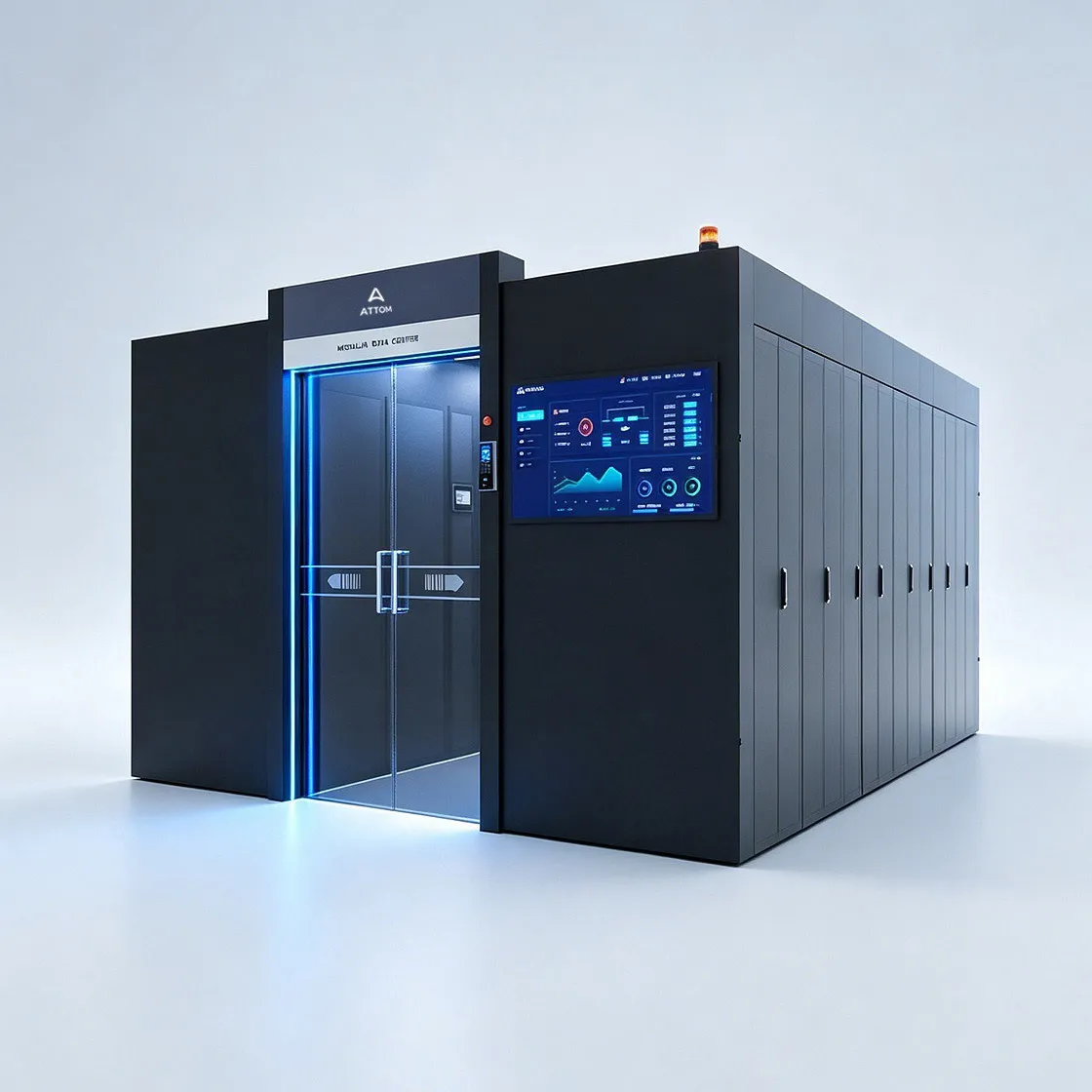
ATTOM provides cooling and thermal management solutions for high-density AI infrastructure, including Direct-to-Chip Liquid Cooling, Immersion Cooling, and AI Modular Data Center designed for GPU-intensive workloads.