Modular Data Center: Complete Guide for 2026 →
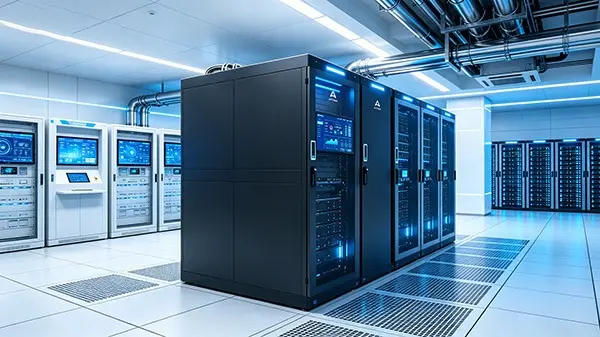
A Modular Data Center is a data center architecture built from standardized, scalable modules that integrate IT infrastructure, power, cooling, networking, monitoring, and other critical systems. Instead of constructing every part of a facility as a one-time, site-built project, modular data centers use repeatable infrastructure units that can be manufactured, integrated, tested, deployed, and expanded according to changing capacity requirements.
Modular data centers are increasingly used for enterprise IT, edge computing, high-performance computing, AI infrastructure, and other applications where deployment speed, scalability, space efficiency, and infrastructure flexibility are important.
The concept of modular infrastructure is closely related to prefabricated data centers, but the two terms describe different aspects of data center development. Modular refers primarily to the architecture and deployment model, while prefabrication refers to how infrastructure is manufactured and assembled. A modular data center can use prefabricated components, and a prefabricated data center can use a modular architecture.
As AI workloads increase rack power density and create new requirements for cooling, power distribution, and deployment speed, modular architecture is becoming an important approach for building scalable high-density computing infrastructure.
What Is a Modular Data Center?
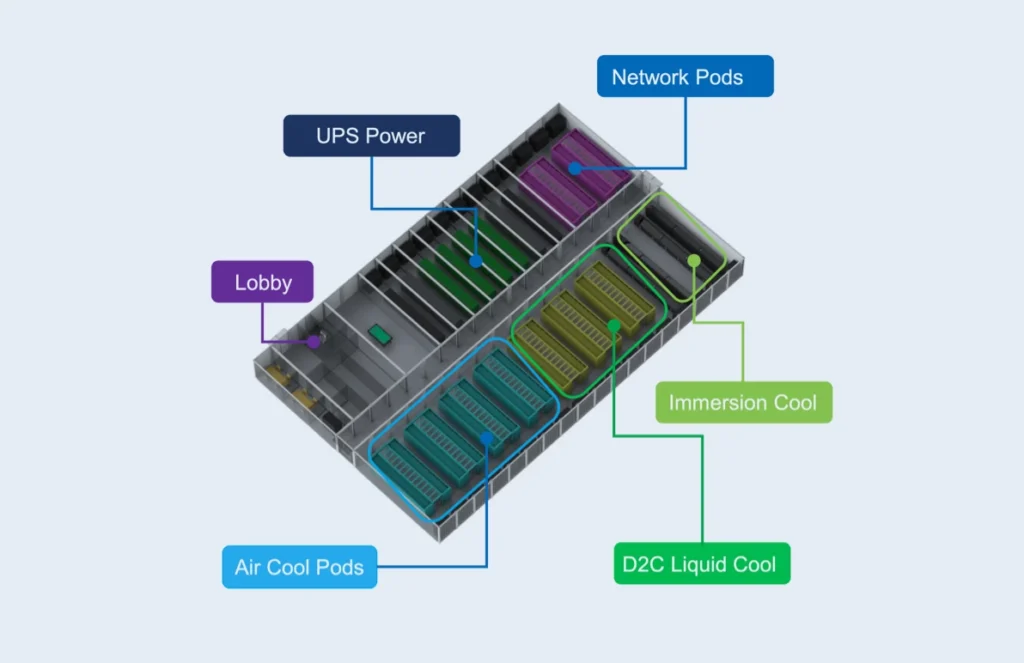
A modular data center is a data center built from standardized infrastructure modules that can be deployed individually or combined into larger systems.
A module may integrate one or more infrastructure functions, such as:
- IT racks and server space
- Power distribution
- UPS systems
- Cooling systems
- Network infrastructure
- Fire protection
- Environmental monitoring
- Physical security
- DCIM and intelligent management systems
Instead of designing every infrastructure element as a completely independent system, modular architecture coordinates these components into repeatable configurations.
This allows organizations to deploy a defined amount of computing capacity and add additional modules as demand increases.
Modular Data Center vs. Traditional Data Center
Traditional data centers are often designed and constructed as large, site-specific facilities. Major systems are engineered, installed, and commissioned at the deployment location.
A modular data center uses a more standardized approach.
| Feature | Modular Data Center | Traditional Data Center |
|---|---|---|
| Architecture | Standardized modules | Site-specific facility |
| Deployment | Modular and repeatable | Primarily onsite construction |
| Scalability | Add or reconfigure modules | Major facility expansion |
| Manufacturing | Can be factory-integrated | Mostly site-based |
| Deployment speed | Generally faster | Generally longer |
| Site flexibility | High | More limited |
| Expansion | Incremental | Often requires major planning |
| Applications | Enterprise, edge, AI, HPC, remote sites | Enterprise, hyperscale, colocation, large campuses |
The primary advantage of modular architecture is not simply that a module is smaller than a traditional data center. Its value comes from standardization, repeatability, integration, and scalable deployment.
How Does a Modular Data Center Work?
A modular data center combines several infrastructure layers into a coordinated architecture.
The exact configuration depends on the workload, capacity requirement, site conditions, power availability, cooling requirements, and desired level of redundancy.
IT Infrastructure
The IT layer provides the physical environment for servers, GPUs, storage, networking equipment, and other computing systems.
Depending on the application, a modular data center may be designed around:
- Standard enterprise servers
- High-density GPU servers
- AI training clusters
- AI inference infrastructure
- Edge computing systems
- Telecom equipment
- High-performance computing systems
Rack density is an important design parameter because it directly affects both power distribution and cooling requirements.
Critical Power Infrastructure
Power infrastructure supplies and protects the IT load.
A modular data center may integrate:
- Utility power distribution
- UPS systems
- PDUs
- Backup power
- Battery systems
- Power monitoring
- Intelligent power management
The power architecture should be designed together with the IT load rather than added after the computing infrastructure has been selected.
For high-density AI workloads, this becomes particularly important because increasing rack power can quickly affect upstream electrical infrastructure, distribution capacity, UPS sizing, and thermal requirements.
Cooling Infrastructure
Cooling removes heat generated by computing equipment and maintains appropriate operating conditions.
Depending on rack density and application requirements, modular data centers can use:
- Precision air cooling
- In-row cooling
- Rear-door heat exchangers
- Direct-to-chip liquid cooling
- Immersion cooling
- Hybrid air and liquid cooling
For conventional enterprise workloads, air cooling may remain sufficient. For high-density AI infrastructure, liquid cooling can become an important part of the overall system architecture.
Monitoring and Management
A modular data center should also provide visibility into infrastructure performance.
Monitoring can cover:
- Temperature
- Humidity
- Power consumption
- Cooling performance
- UPS status
- Rack conditions
- Environmental alarms
- Equipment status
- Energy efficiency
DCIM and intelligent monitoring systems can help operators manage distributed modular infrastructure from a centralized operational framework.
Modular Data Center Architecture
A modular data center should be viewed as an integrated infrastructure platform rather than a standalone enclosure.
A typical architecture includes several interconnected layers.
IT Layer
The IT layer contains the computing equipment and network infrastructure.
Its design determines:
- Rack count
- Rack density
- Server configuration
- GPU requirements
- Network topology
- Storage requirements
- Future capacity requirements
Power Layer
The power layer provides reliable electrical distribution from the utility or upstream power source to the IT equipment.
It may include:
- Switchgear
- UPS
- PDU
- Busway
- Battery systems
- Monitoring systems
The architecture should provide sufficient capacity for both current and future loads.
Cooling Layer
The cooling layer manages the heat generated by IT equipment.
For low- and medium-density deployments, precision air cooling may be sufficient.
For high-density AI workloads, the architecture may incorporate:
- Direct-to-chip cooling
- Rear-door heat exchangers
- Coolant distribution systems
- Chillers
- Heat rejection systems
- Hybrid cooling
Physical Infrastructure Layer
This layer provides the physical environment for the infrastructure.
Depending on the modular configuration, it may include:
- Enclosures
- Containers
- Shelters
- Rack-level modules
- Indoor modular rooms
- Outdoor equipment structures
The physical form should be selected based on deployment requirements rather than treated as the definition of modular architecture.
Management Layer
The management layer provides operational visibility and control.
It can integrate:
- Environmental monitoring
- Power monitoring
- Cooling monitoring
- Security
- Asset management
- DCIM
The result is a coordinated infrastructure platform that can be deployed and operated as a repeatable system.
Types of Modular Data Centers
Modular data centers can be classified in several ways, including physical form factor, deployment environment, workload, and infrastructure configuration.
Container Modular Data Center
A container modular data center integrates IT and supporting infrastructure into a containerized enclosure.
Containerized designs are particularly useful when organizations need:
- Rapid deployment
- Portable infrastructure
- Remote computing capacity
- Edge deployments
- Temporary or transitional capacity
- Harsh-environment deployment
A container data center is therefore one possible physical implementation of modular architecture.
For a detailed explanation of containerized infrastructure, see ATTOM’s Container Data Center resources.
Micro Modular Data Center
A micro modular data center provides a smaller-scale infrastructure environment for localized computing.
Typical applications include:
- Branch offices
- Retail locations
- Manufacturing facilities
- Telecom sites
- Edge computing
- AI inference
- Remote facilities
Micro and modular describe different characteristics. Micro generally emphasizes deployment scale, while modular emphasizes architecture and repeatability.
Skid-Based Modular Data Center
Skid-based systems place integrated infrastructure on standardized structural platforms or skids.
They can be useful for:
- Power systems
- Cooling systems
- Mechanical infrastructure
- Process equipment
- Data center support systems
Skid-based architecture can simplify transportation, factory integration, installation, and future replication.
Indoor Modular Data Center
Indoor modular systems are deployed within existing buildings or dedicated facilities.
They can be used when organizations want to expand data center capacity without constructing an entirely new building.
Indoor modular systems may integrate:
- IT racks
- Containment
- Power distribution
- Cooling
- Monitoring
- Security
Outdoor Modular Data Center
Outdoor modular systems are designed for deployment outside conventional buildings.
They can support:
- Edge computing
- Remote infrastructure
- Telecom
- Industrial applications
- Distributed AI
- Harsh or space-constrained environments
Outdoor deployment requires careful consideration of environmental protection, thermal conditions, security, power availability, and maintenance access.
Prefabricated Modular Data Center: What Is the Difference?
The terms modular data center and prefabricated data center are closely related but should not be treated as synonyms.
A modular data center describes the architecture and deployment approach.
A prefabricated data center describes infrastructure that is manufactured or assembled in a controlled factory environment before being delivered to the deployment site.
A prefabricated modular data center combines both concepts.
| Concept | Primary Meaning |
|---|---|
| Modular Data Center | Standardized architecture and scalable deployment |
| Prefabricated Data Center | Factory manufacturing and pre-assembly |
| Prefabricated Modular Data Center | Modular architecture combined with factory prefabrication |
| Container Data Center | Containerized physical form |
| Micro Data Center | Small-scale deployment |
| Edge Data Center | Location and workload model |
| Modular AI Data Center | Modular architecture optimized for AI workloads |
This distinction is important because modular architecture does not require every component to be manufactured in a factory, while prefabrication does not necessarily define the complete architecture of a facility.
In practice, combining modular architecture with prefabrication can provide significant benefits in standardization, quality control, deployment speed, and scalability.
Modular Data Center Design
Modular data center design should begin with the workload rather than the enclosure.
A reliable design process typically considers computing, power, cooling, physical infrastructure, monitoring, and future expansion as an integrated system.
Define the IT Load
The first step is to determine the computing requirement.
Important parameters include:
- Total IT capacity
- Number of racks
- Rack power density
- Server configuration
- GPU requirements
- Network capacity
- Storage requirements
- Expected growth
For AI infrastructure, GPU density and rack power can be substantially higher than conventional enterprise workloads.
Determine Power Requirements
Power capacity should be calculated from the expected IT load and infrastructure overhead.
Design considerations include:
- Utility power
- UPS capacity
- Distribution architecture
- PDU configuration
- Backup power
- Redundancy
- Future expansion
Modular architecture can allow power capacity to grow in stages instead of requiring the entire future capacity to be installed on day one.
Design the Cooling System
Cooling design depends heavily on rack density.
Traditional enterprise racks may be adequately supported by precision air cooling.
Higher-density AI racks may require liquid cooling technologies such as:
- Direct-to-chip cooling
- Rear-door heat exchangers
- Coolant distribution systems
- Immersion cooling
The cooling system should be selected together with the server and rack architecture.
Plan for Expansion
One of the primary reasons to choose modular architecture is future scalability.
A good modular design should define:
- Initial capacity
- Expansion increments
- Physical expansion space
- Power expansion
- Cooling expansion
- Network expansion
- Maintenance requirements
The objective is to avoid redesigning the entire facility every time computing requirements increase.
Modular Data Center Cooling
Cooling is becoming one of the most important design considerations for modular data centers.
As computing density increases, thermal infrastructure can become a limiting factor.
Air Cooling
Air cooling remains suitable for many conventional IT environments.
It can be implemented through:
- Precision air conditioners
- In-row cooling
- Containment
- Room-level cooling
Air cooling is relatively straightforward and can be appropriate when rack power density remains within the practical range of air-based thermal management.
Rear-Door Heat Exchangers
Rear-door heat exchangers remove heat from server exhaust air through a liquid-cooled heat exchanger mounted at the rear of the rack.
They can be useful when organizations want to increase rack density without replacing the entire IT environment.
Direct-to-Chip Liquid Cooling
Direct-to-chip cooling transfers heat directly from high-power processors through cold plates and a liquid cooling loop.
It is particularly relevant to:
- AI servers
- GPU clusters
- HPC systems
- High-density racks
Direct-to-chip cooling can be integrated into modular infrastructure when rack-level thermal requirements exceed practical air-cooling capacity.
Immersion Cooling
Immersion cooling places IT equipment in a specialized heat-transfer fluid.
It can provide high heat removal capability for certain high-density computing environments, although it requires different equipment, maintenance procedures, fluid management, and operational practices.
Hybrid Cooling
Many modern modular AI data centers use a combination of cooling technologies.
For example:
- Liquid cooling for high-density GPU racks
- Air cooling for conventional IT
- Rear-door heat exchangers for transitional deployments
This approach allows the cooling architecture to match different rack densities within the same modular environment.
Modular Data Centers for AI Infrastructure
AI workloads are changing the requirements for data center infrastructure.
AI training and inference can require high-density GPU servers, significant electrical capacity, advanced thermal management, and rapid deployment.
This has created growing interest in the AI Modular Data Center.
An AI modular data center is a modular infrastructure platform designed specifically to support AI workloads.
Why AI Needs Modular Infrastructure
AI infrastructure creates several challenges:
- High rack power density
- Rapid capacity growth
- Increased cooling requirements
- Large electrical loads
- Complex thermal management
- Short deployment timelines
- Frequent infrastructure upgrades
Traditional construction can struggle when capacity must be deployed quickly and expanded repeatedly.
Modular architecture provides a way to standardize the infrastructure platform and replicate it as AI capacity grows.
AI Modular Data Center Architecture
A typical AI modular data center may integrate:
- High-density GPU racks
- High-capacity power distribution
- UPS systems
- Liquid cooling
- Network infrastructure
- Monitoring and DCIM
- Physical security
- Scalable modular enclosures
The architecture should be designed around the AI workload instead of simply placing GPU servers into an existing conventional data center.
AI Prefab Data Center
An AI Prefab Data Center combines AI-ready infrastructure with factory prefabrication.
The factory environment can be used to integrate and test:
- Power systems
- Cooling systems
- Racks
- Monitoring
- Containment
- Network infrastructure
- Mechanical systems
The major advantage is that more engineering and integration work can be completed before the infrastructure reaches the deployment site.
This can reduce onsite coordination and help organizations deploy AI capacity more consistently across multiple locations.
Modular AI Data Centers and Liquid Cooling
AI workloads often require a closer relationship between computing, power, and thermal infrastructure.
A modular AI architecture can integrate liquid cooling into the infrastructure platform from the beginning.
This is particularly useful when deploying:
- High-density GPU clusters
- AI training systems
- AI inference infrastructure
- HPC environments
- Edge AI systems
ATTOM’s AgileCore platform is designed around this approach, combining AI-ready modular architecture with liquid cooling options including direct-to-chip cooling, immersion cooling, and rear-door heat exchange.
Modular Data Center Power Infrastructure
Power infrastructure is another critical component of modular design.
As AI rack density increases, electrical infrastructure must scale accordingly.
A modular power architecture may include:
- UPS
- PDU
- Busway
- Battery systems
- BESS
- Power monitoring
- Distribution equipment
Modular UPS
UPS systems protect IT equipment from power interruptions and disturbances.
In modular environments, UPS capacity can be configured according to the initial deployment and expanded as additional modules are added.
Modular PDU
PDUs distribute electrical power from upstream infrastructure to IT racks.
For high-density deployments, the PDU architecture must account for:
- Rack power
- Voltage
- Current
- Redundancy
- Monitoring
- Future capacity
Energy Storage
Battery energy storage systems can provide additional flexibility for modern data center infrastructure.
Depending on the application, energy storage can support:
- Backup power
- Peak management
- Energy optimization
- Renewable energy integration
- Grid interaction
The exact configuration depends on the site’s electrical infrastructure and operating strategy.
Benefits of Modular Data Centers
The benefits of modular architecture depend on how the system is designed and deployed.
Faster Deployment
Factory integration and standardized modules can reduce the amount of work that must be completed onsite.
This can shorten:
- Installation
- Integration
- Commissioning
- Deployment
The actual deployment schedule depends on site preparation, permitting, utility availability, infrastructure configuration, and project scope.
Scalable Capacity
Modular infrastructure can grow as demand increases.
Instead of constructing the entire future capacity at once, organizations can deploy an initial configuration and add modules later.
Standardization
Standardized modules allow organizations to repeat similar infrastructure configurations across multiple sites.
This is particularly useful for:
- Edge deployments
- Enterprise expansion
- Distributed AI
- Telecom
- Multi-site infrastructure
Predictable Manufacturing
Factory-based integration can provide greater control over manufacturing and testing conditions.
This can reduce some of the variability associated with complex onsite installation.
Flexible Deployment
Modular systems can be adapted to different physical environments.
Depending on the design, they can be deployed:
- Inside existing buildings
- In dedicated facilities
- Outdoors
- At edge locations
- In remote environments
Easier Expansion
Because the infrastructure is designed as modules, future expansion can be planned around repeatable capacity increments.
This can be particularly valuable when future IT demand is difficult to predict.
Modular Data Center vs. Prefabricated Data Center
Although the concepts overlap, they answer different questions.
Modular Data Center: How is the infrastructure structured and expanded?
Prefabricated Data Center: Where and how is the infrastructure manufactured and assembled?
A modular data center can use prefabricated infrastructure, and prefabricated infrastructure can be used within a modular architecture.
For this reason, prefabricated modular data centers are increasingly relevant when organizations need both rapid deployment and scalable infrastructure.
The distinction also helps organizations evaluate vendors more accurately. A product described as “prefabricated” should still be evaluated based on its architecture, scalability, power system, cooling capability, monitoring, maintainability, and expansion strategy.
Prefabricated Data Centers: Types, Architecture, Benefits, and Solutions →
Modular Data Center vs. Container Data Center
A container data center is generally defined by its containerized physical enclosure.
A modular data center is defined by its standardized and scalable architecture.
Therefore:
A container data center can be a modular data center, but not every modular data center is a container data center.
Modular systems can use:
- Containers
- Indoor rooms
- Shelters
- Rack-level modules
- Skid-based systems
- Other standardized structures
This distinction becomes important when selecting infrastructure for AI, enterprise, edge, or industrial applications.
Container Data Center: Definition, Benefits, Cost & Deployment Guide →
Modular Data Center vs. Micro Data Center
A micro data center generally focuses on compact, localized deployment.
A modular data center focuses on standardized architecture and scalable deployment.
They can overlap.
For example, a rack-level micro data center can use modular architecture and may be deployed as part of a larger distributed infrastructure strategy.
The key difference is that micro describes scale, while modular describes architecture and deployment methodology.
What Is a Micro Data Center? Definition, Types, Components, Benefits & Solutions →
Applications of Modular Data Centers
Modular data centers can support a wide range of workloads and deployment environments.
Enterprise IT
Organizations can use modular infrastructure to expand computing capacity without constructing an entirely new data center.
Applications include:
- Private cloud
- Enterprise applications
- Storage
- Virtualization
- Business-critical IT
Edge Computing
Edge deployments often require compact, rapidly deployable infrastructure.
Modular data centers can provide standardized computing environments closer to users, devices, and data sources.
AI Infrastructure
AI workloads are one of the strongest emerging applications for modular infrastructure.
AI modular data centers can combine:
- High-density computing
- Liquid cooling
- High-capacity power
- Rapid deployment
- Modular scalability
High-Performance Computing
HPC workloads can generate significant power and thermal requirements.
Modular architecture can provide a repeatable platform for deploying specialized high-density computing environments.
Telecom and Distributed Infrastructure
Telecom operators and distributed infrastructure providers can use modular systems to deploy computing capacity across multiple locations.
Remote and Harsh Environments
Outdoor and containerized modular systems can be designed for locations where conventional data center construction is difficult or impractical.
Environmental protection, cooling, power availability, security, and maintenance access must be incorporated into the design.
How to Choose a Modular Data Center
Selecting a modular data center should begin with the infrastructure requirements rather than the physical form factor.
1. Define the Workload
Determine:
- Enterprise IT
- Edge computing
- AI
- HPC
- Telecom
- Industrial computing
2. Determine Rack Density
Rack power density affects the entire infrastructure architecture.
Higher-density racks generally require greater electrical capacity and more advanced cooling.
3. Evaluate Cooling Requirements
Determine whether the deployment requires:
- Air cooling
- Rear-door heat exchange
- Direct-to-chip liquid cooling
- Immersion cooling
- Hybrid cooling
4. Define Initial and Future Capacity
Identify both:
- Initial IT load
- Expected future expansion
A modular solution should provide a practical path from the first deployment to future capacity.
5. Evaluate Power Architecture
Consider:
- Utility power
- UPS
- PDU
- Redundancy
- Backup power
- Energy storage
6. Evaluate Deployment Environment
Consider:
- Indoor or outdoor installation
- Available floor space
- Climate
- Security
- Site access
- Utility availability
- Maintenance access
7. Evaluate Integration and Testing
Ask how much of the infrastructure is integrated and tested before delivery.
The more complex the system, the more important factory integration and commissioning processes become.
8. Evaluate Lifecycle Support
A modular data center is not only a deployment product.
Evaluate:
- Maintenance
- Spare parts
- Monitoring
- Expansion
- Cooling service
- Power service
- Technical support
When Should You Use a Modular Data Center?
Modular architecture is particularly attractive when an organization needs one or more of the following:
- Faster deployment
- Incremental capacity expansion
- Standardized infrastructure
- Distributed computing
- Edge deployment
- High-density AI infrastructure
- Flexible site deployment
- Repeatable multi-site deployments
It may be less appropriate when a project requires a highly customized permanent facility where the economics and operational requirements favor conventional construction.
The right decision depends on workload, capacity, site conditions, project schedule, capital strategy, and long-term expansion requirements.
ATTOM Modular Data Center Solutions
ATTOM develops modular data center infrastructure that integrates IT space with critical power, cooling, monitoring, and other supporting systems.
The portfolio includes different modular configurations for enterprise, edge, containerized, and AI workloads.
AgileRax
AgileRax is a rack-level micro data center platform designed for compact deployments and distributed computing environments.
AgileCub
AgileCub is a container data center solution designed for rapidly deployable modular infrastructure, including edge and AI applications.
AgileMod
AgileMod is a containment-type prefabricated modular data center solution that integrates IT racks, power, cooling, containment, and intelligent monitoring into a standardized architecture.
AgileHub
AgileHub provides a shelter-based modular data center configuration for applications requiring flexible physical deployment.
AgileCore
AgileCore is ATTOM’s AI-focused prefabricated modular data center platform.
It is designed for high-density AI infrastructure and integrates modular architecture with advanced liquid cooling technologies.
ATTOM’s broader modular portfolio combines data center modules with precision cooling, liquid cooling, critical power, DCIM, and rack infrastructure, allowing infrastructure to be configured according to workload and deployment requirements.
The Future of Modular Data Centers
The evolution of computing is changing the way data centers are designed.
AI workloads are increasing power density. Edge computing is distributing workloads across more locations. Organizations are also under pressure to deploy infrastructure faster while maintaining reliability and energy efficiency.
These trends favor infrastructure that is:
- Standardized
- Scalable
- Repeatable
- High-density ready
- Cooling-aware
- Power-efficient
- Easier to deploy
Modular architecture provides a framework for addressing these requirements.
The future of modular data centers will not simply be about putting a data center into a container or building smaller facilities. The more important trend is the integration of computing, power, cooling, monitoring, and physical infrastructure into scalable infrastructure platforms.
For AI infrastructure in particular, the combination of modular architecture, prefabrication, high-density power, and advanced liquid cooling can provide a practical path for deploying computing capacity as demand evolves.
Frequently Asked Questions About Modular Data Centers
What is a Modular Data Center?
A modular data center is a data center architecture built from standardized infrastructure modules that integrate IT, power, cooling, networking, monitoring, and other critical systems. Modules can be deployed individually or combined into larger systems.
What is the difference between a modular and prefabricated data center?
Modular describes the architecture and scalable deployment model, while prefabricated describes the manufacturing and assembly approach. A prefabricated data center can use modular architecture, creating a prefabricated modular data center.
Is a container data center a modular data center?
A container data center can be a modular data center when it uses standardized infrastructure modules and a scalable deployment architecture. However, modular data centers can also use indoor rooms, shelters, rack-level systems, and other physical configurations.
What is an AI Modular Data Center?
An AI modular data center is a modular infrastructure platform designed for AI workloads. It typically integrates high-density power, advanced cooling, GPU-ready racks, monitoring, and scalable infrastructure.
What is an AI Prefab Data Center?
An AI prefab data center combines AI-ready computing infrastructure with factory-prefabricated systems. Power, cooling, racks, monitoring, and other infrastructure can be integrated and tested before deployment.
Can modular data centers use liquid cooling?
Yes. Modular data centers can integrate rear-door heat exchangers, direct-to-chip liquid cooling, immersion cooling, or hybrid cooling systems depending on rack density and workload requirements.
Are modular data centers scalable?
Yes. One of the main advantages of modular architecture is the ability to add infrastructure modules as computing requirements increase. The scalability of a specific solution depends on its power, cooling, physical space, and expansion architecture.
Are modular data centers suitable for AI workloads?
Yes. Modular architecture is increasingly suitable for AI infrastructure because it can combine high-density power, advanced cooling, standardized deployment, and scalable expansion.
Are modular data centers faster to deploy than traditional data centers?
Modular and prefabricated approaches can reduce onsite construction and integration work, potentially shortening deployment schedules. Actual deployment time depends on site preparation, permitting, utility availability, system complexity, and project scope.
Conclusion
A Modular Data Center is more than a smaller or prefabricated version of a traditional data center. It is an infrastructure architecture built around standardized modules, integrated systems, repeatable deployment, and scalable expansion.
The approach can support a wide range of applications, from enterprise IT and edge computing to high-performance computing and AI infrastructure.
As computing density increases, modular architecture is becoming particularly relevant to AI because it can bring power, cooling, computing, monitoring, and physical infrastructure together into a coordinated deployment model.
The most effective modular data center strategy begins with the workload and works outward to define rack density, power, cooling, physical architecture, monitoring, deployment method, and future expansion.
For organizations deploying AI and other high-density computing environments, the combination of modular architecture, prefabrication, advanced cooling, and scalable power infrastructure provides a practical foundation for building data center capacity faster and adapting it as computing requirements evolve.
ATTOM provides modular data center solutions spanning micro, containerized, containment, shelter, and AI-ready architectures, with integrated cooling, critical power, monitoring, and infrastructure technologies for modern data center deployments.
Related Data Center Infrastructure Topics
- AI Data Center
- Micro Data Center
- Edge Data Center
- Prefabricated Data Center
- Container Data Center
- Edge Computing
- Liquid Cooling
- DCIM
For organizations evaluating distributed computing infrastructure, these topics should be considered as connected parts of the broader data center infrastructure architecture.