Edge Data Center: A Complete Guide to Architecture, Infrastructure, Cooling, and Deployment
Edge data centers bring computing, storage, networking, and critical infrastructure closer to where data is generated and where applications are used. Unlike traditional centralized data centers, they are designed for distributed deployment, lower latency, localized processing, and operation across a wide range of environments.
As AI inference, 5G, IoT, industrial automation, video analytics, and other real-time applications continue to generate data outside centralized facilities, edge data centers are becoming an important part of distributed IT infrastructure.
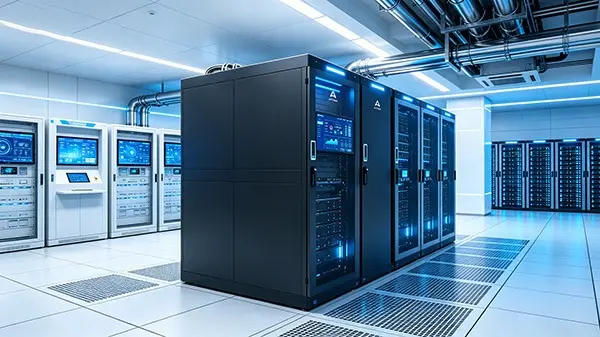
An edge data center can range from a small, self-contained micro data center to a multi-rack modular or containerized facility. The appropriate architecture depends on workload requirements, location, power availability, cooling conditions, connectivity, security, availability, and operational requirements.
This guide explains what an edge data center is, how it differs from related infrastructure concepts, how edge data centers are designed, and which power, cooling, monitoring, and deployment technologies are commonly used.
What Is an Edge Data Center?
An edge data center is a data center deployed close to the network edge, users, devices, or data sources to provide localized computing, storage, networking, and IT infrastructure with lower latency and greater proximity than a centralized data center.
The term “edge” primarily describes where the data center is deployed, rather than a specific physical size or equipment configuration.
An edge data center may support many of the same functions as a conventional data center, including:
- Compute and server infrastructure
- Storage
- Networking
- Power distribution
- Backup power
- Cooling
- Environmental control
- Physical security
- Monitoring and management
However, edge facilities typically operate under different constraints because they are distributed across many locations. They may need to operate in branch offices, telecom facilities, manufacturing plants, retail locations, remote sites, or other environments that were not originally designed as conventional data centers.
Industry guidance on edge data centers has highlighted location, physical and logical security, operational risk, and critical infrastructure as important considerations for distributed deployments. ATTOM’s existing technical material on Edge Data Centers also reflects these characteristics.
Why Are Edge Data Centers Important?
Traditional cloud and data center architectures concentrate computing resources in relatively large centralized facilities. This architecture provides significant advantages in scalability, resource utilization, and centralized management, but it is not optimal for every application.
Applications that depend on real-time processing may be affected by network distance, bandwidth requirements, or the need to continuously transfer large amounts of data to centralized infrastructure.
Edge data centers address these limitations by moving selected computing and storage resources closer to the point where data is generated or consumed.
Typical benefits include:
Lower Latency
Processing data closer to users, machines, sensors, or other endpoints can reduce network latency and improve application responsiveness.
This is particularly important for industrial control, autonomous systems, real-time video analytics, telecommunications, AI inference, and other latency-sensitive workloads.
Local Data Processing
Edge infrastructure can process and analyze data locally instead of sending all raw data to a centralized facility.
This can reduce network traffic while allowing organizations to retain critical processing capabilities at the edge.
Improved Application Resilience
A distributed architecture can allow applications to continue operating locally even when connectivity to a central cloud or data center is temporarily degraded.
The appropriate level of local resiliency depends on the application’s availability requirements and the architecture of the overall IT environment.
Distributed Capacity
Organizations can deploy computing capacity where it is needed rather than building every application around a centralized data center.
This is particularly useful when IT infrastructure must be deployed across many geographically distributed locations.
Edge Data Center vs. Edge Computing
Edge computing and edge data centers are closely related, but they describe different things.
Edge computing is a computing architecture. Edge data centers are physical infrastructure used to support computing at or near the edge.
Edge computing determines where computing and data processing take place. An edge data center provides the physical environment in which servers, networking equipment, power systems, cooling systems, and other infrastructure can operate.
An edge computing deployment may use:
- Edge data centers
- Micro data centers
- Telecom facilities
- On-premises IT rooms
- Industrial computing environments
- Network equipment locations
- Other distributed computing nodes
Therefore, an edge data center is best understood as one type of physical infrastructure supporting an edge computing architecture, rather than as a synonym for edge computing.
For a broader explanation of the computing architecture itself, see ATTOM’s Edge Computing resources.
Edge Data Center vs. Micro Data Center
Micro data centers are one of the most common infrastructure approaches for edge deployments, but the two terms are not interchangeable.
A micro data center is generally a compact, integrated data center system that combines IT infrastructure with supporting power, cooling, security, and monitoring systems.
An edge data center is defined primarily by its deployment location and role in a distributed architecture.
As a result:
A micro data center can serve as an edge data center, but not every edge data center is necessarily a micro data center.
An edge data center may consist of a single cabinet, several racks, a modular room, or a larger prefabricated and containerized facility.
ATTOM’s Micro Data Center solutions integrate power, cooling, networking, security, and monitoring into compact systems designed for distributed IT and edge computing applications.
For detailed information about the technology, see What Is a Micro Data Center.
Types of Edge Data Centers
There is no single physical configuration for an edge data center. The appropriate design depends on workload density, site conditions, deployment scale, availability requirements, and operating environment.
Micro Edge Data Centers
Micro edge data centers are compact systems designed for locations where IT capacity is relatively limited and space is constrained.
They are suitable for applications such as:
- Enterprise branches
- Retail locations
- Industrial sites
- Smart manufacturing
- Telecom infrastructure
- Local AI inference
- Video processing
- IoT deployments
Integrated power, cooling, security, and remote management can simplify deployment where conventional data center infrastructure is unavailable.
Modular Edge Data Centers
Modular edge data centers use standardized or prefabricated modules that can be manufactured, tested, transported, and deployed with less on-site construction than conventional facilities.
Modular architectures can support:
- Faster deployment
- Repeatable configurations
- Standardized engineering
- Flexible capacity expansion
- Deployment across multiple locations
Modularity is particularly valuable when an organization needs to replicate similar edge infrastructure across a large geographic footprint.
Containerized Edge Data Centers
Containerized data centers place IT and facility infrastructure within standardized enclosures or containers.
They can be useful for deployments where portability, environmental protection, rapid installation, and independent infrastructure are important.
Containerized architectures can also support higher-density workloads when appropriate power and cooling systems are integrated into the design.
Telecom Edge Data Centers
Telecommunications networks are a major environment for edge infrastructure because network operators need computing capacity closer to users and connected devices.
Telecom edge facilities may support:
- 5G applications
- Network functions
- Content delivery
- Local processing
- IoT
- Video analytics
- Low-latency services
These deployments typically place particular emphasis on compact design, reliability, remote management, physical security, and environmental adaptability.
Edge Colocation Data Centers
Edge colocation provides shared infrastructure for multiple customers or applications at distributed locations.
Compared with centralized colocation, edge colocation emphasizes geographic proximity to users, networks, and workloads.
ATTOM’s existing Edge Colocation solution focuses on prefabricated micro data centers for distributed deployments ranging from small edge cloud resources to multi-rack locations and containerized infrastructure.
Edge Data Center Architecture
An edge data center architecture should be designed as an integrated infrastructure system rather than simply a collection of IT racks.
A typical architecture includes five major layers:
- IT infrastructure
- Power infrastructure
- Cooling and thermal management
- Network and connectivity
- Monitoring, security, and management
The exact configuration depends on the workload and site.
IT Infrastructure
The IT layer may include:
- Servers
- GPUs
- Storage
- Network switches
- Routers
- Telecommunications equipment
- Edge computing appliances
The required rack count and power density should be established before the facility infrastructure is designed.
Power Infrastructure
Power systems are critical because edge sites may have less reliable or less redundant utility infrastructure than large centralized data centers.
Typical components include:
- Utility power
- UPS systems
- Power distribution units
- Rack PDUs
- Backup generators where required
- Surge protection
- Monitoring systems
The appropriate redundancy level should be determined by business and application requirements rather than by applying the same topology to every edge site.
Cooling Infrastructure
Cooling is one of the most important design considerations for edge facilities.
The cooling architecture should account for:
- IT load
- Rack power density
- Ambient temperature
- Humidity
- Available space
- Outdoor conditions
- Required availability
- Maintenance requirements
Low-density edge deployments may use precision air cooling, while higher-density systems may require rear-door heat exchangers, direct-to-chip liquid cooling, or other liquid-assisted architectures.
ATTOM’s data center design guidance emphasizes designing cooling around actual rack power density and using liquid cooling where high-density workloads exceed the practical limits of conventional air cooling.
Network and Connectivity
Connectivity is fundamental to edge infrastructure because the value of an edge deployment depends partly on its ability to communicate with users, devices, cloud infrastructure, and other data centers.
Network architecture should consider:
- WAN connectivity
- Local area networking
- Redundant links
- Network security
- Bandwidth requirements
- Latency
- Traffic routing
- Remote access
The edge data center should be designed as part of a broader distributed infrastructure architecture rather than as an isolated facility.
Monitoring and Management
Many edge data centers operate in locations without dedicated data center personnel.
Remote monitoring and management therefore become increasingly important.
A DCIM or integrated monitoring system can provide visibility into:
- Temperature
- Humidity
- Power consumption
- UPS status
- Cooling equipment
- Door access
- Smoke or environmental alarms
- Server and rack conditions
- Equipment failures
ATTOM’s Micro Data Center approach integrates monitoring and remote management to reduce the operational burden associated with distributed sites.
Edge Data Center Cooling
Cooling requirements vary considerably between edge deployments.
A small branch-office edge deployment may have relatively low rack density and can often rely on precision air cooling.
A high-density AI inference or video processing deployment may have substantially greater thermal loads and require a more advanced thermal management architecture.
Precision Air Cooling
Precision cooling systems provide controlled temperature and humidity conditions for IT equipment.
They are suitable for many conventional edge deployments where rack density remains within the practical range of air cooling.
Rear-Door Heat Exchangers
Rear-door heat exchangers can remove heat from high-density racks by transferring heat from the rack exhaust air into a liquid cooling loop.
This approach can increase cooling capacity without requiring every server to be converted to direct liquid cooling.
Direct-to-Chip Liquid Cooling
Direct-to-chip cooling transfers heat directly from high-power processors through cold plates and a liquid cooling loop.
It becomes increasingly relevant for high-density CPUs, GPUs, AI servers, and other workloads where traditional air cooling becomes less effective.
ATTOM’s ByteCool direct-to-chip liquid cooling platform is designed for AI and HPC workloads and includes CDU-based liquid cooling configurations.
For a broader technical discussion, see ATTOM’s Liquid Cooling resources.
Edge Data Center Power and Reliability
Distributed sites can present different power challenges from centralized data centers.
An edge deployment may operate in a commercial building, factory, telecom facility, outdoor enclosure, or remote location. The availability and quality of utility power can therefore vary considerably.
A power design should evaluate:
- Utility availability
- Required UPS capacity
- Runtime requirements
- Generator requirements
- Power redundancy
- Rack power density
- Distribution topology
- Monitoring
- Maintenance access
The goal is not necessarily to reproduce a hyperscale power architecture at every edge location.
Instead, the infrastructure should provide the level of availability required by the specific application.
Edge Data Center Security
Physical and logical security are particularly important for distributed edge infrastructure.
A centralized data center typically benefits from controlled facilities, dedicated security personnel, and established operating procedures. Edge infrastructure may instead be located in offices, factories, retail sites, telecom facilities, or remote locations.
Security considerations can include:
Physical Security
- Access control
- Locked racks or enclosures
- Door monitoring
- Video surveillance
- Tamper detection
- Environmental protection
Network Security
- Network segmentation
- Secure remote access
- Firewall protection
- Authentication
- Encryption
- Centralized security monitoring
Operational Security
Remote sites should also have clearly defined procedures for maintenance, firmware updates, equipment replacement, incident response, and physical access.
Edge Data Center Design Considerations
Designing an edge data center requires balancing technical requirements with site constraints.
The most important considerations include:
Location
Location directly influences latency, connectivity, power availability, environmental conditions, physical security, and maintenance.
The site should be selected according to the workload’s geographic and network requirements rather than simply the availability of physical space.
Capacity
Capacity planning should consider both current and future IT requirements.
Important parameters include:
- Number of racks
- Rack power density
- Total IT load
- Cooling capacity
- UPS capacity
- Network capacity
- Expansion requirements
Environmental Conditions
Edge sites may be exposed to temperature extremes, humidity, dust, vibration, or other environmental conditions that are uncommon in purpose-built data centers.
The enclosure and cooling system should therefore be selected according to the actual deployment environment.
Availability and Redundancy
Not every application requires the same level of redundancy.
Design decisions may include:
- N
- N+1
- 2N
- Redundant cooling
- Redundant UPS
- Dual power paths
- Network redundancy
The appropriate topology should be determined by business continuity requirements and the consequences of downtime.
Remote Operation
The more geographically distributed the infrastructure becomes, the more important remote monitoring and management become.
An edge data center should ideally provide centralized visibility into distributed power, cooling, environmental, security, and IT conditions.
Edge Data Center Deployment
One of the primary advantages of edge infrastructure is the ability to deploy standardized systems across multiple locations.
A typical deployment process includes:
1. Define the Workload
Determine:
- Compute requirements
- Storage requirements
- Network requirements
- Latency requirements
- Rack density
- Availability requirements
2. Evaluate the Site
Assess:
- Available space
- Utility power
- Connectivity
- Ambient conditions
- Physical security
- Installation constraints
- Maintenance access
3. Select the Infrastructure Architecture
Choose between:
- Micro data center
- Modular data center
- Containerized data center
- Dedicated edge room
- Other integrated infrastructure
4. Design Power and Cooling
Power and cooling should be designed together with the IT load.
For higher-density workloads, the thermal architecture should be established before selecting the final rack and server configuration.
5. Integrate Monitoring and Security
Remote monitoring, access control, environmental sensors, and alarm systems should be integrated before deployment.
6. Factory Integration and Testing
Prefabricated and modular solutions can allow more infrastructure integration and testing to take place before the system reaches the final site.
This can reduce the amount of complex construction and commissioning work required on location.
7. Deploy and Operate
After installation, centralized monitoring and standardized maintenance procedures help organizations manage distributed infrastructure more efficiently.
Edge Data Center Applications
Edge data centers support a wide range of applications where geographic proximity and localized processing are important.
5G and Telecommunications
5G networks generate demand for distributed computing and network infrastructure closer to users.
Edge data centers can support local processing, network functions, content delivery, and other latency-sensitive services.
Smart Manufacturing
Factories increasingly generate large volumes of data from sensors, machines, cameras, and industrial control systems.
Local computing can process this data closer to production equipment while reducing dependence on centralized infrastructure.
AI Inference
AI training is commonly associated with centralized high-performance data centers, but AI inference increasingly takes place closer to users and data sources.
Edge data centers can provide localized GPU and accelerator infrastructure for:
- Video analytics
- Computer vision
- Industrial AI
- Autonomous systems
- Retail analytics
- Real-time decision making
High-density inference workloads may require advanced thermal management, including liquid cooling.
Video Analytics
Video applications can generate significant data volumes.
Local processing allows organizations to analyze video streams closer to cameras and sensors instead of continuously transmitting all raw data to a centralized facility.
Retail and Branch Infrastructure
Retail stores, financial branches, offices, and other distributed business locations may require local computing and networking infrastructure while maintaining centralized IT management.
IoT
IoT deployments can generate data across thousands or millions of distributed devices.
Edge infrastructure can provide local processing, filtering, storage, and analytics before selected information is transmitted to centralized cloud platforms.
Edge Data Center vs. Traditional Data Center
| Factor | Edge Data Center | Traditional Centralized Data Center |
|---|---|---|
| Primary location | Close to users, devices, or network edge | Centralized facility |
| Typical scale | Small to medium, but highly variable | Medium to hyperscale |
| Deployment model | Distributed | Centralized |
| Latency | Optimized for low-latency applications | More dependent on network distance |
| Site conditions | Often variable | Usually purpose-built |
| Remote management | Highly important | Important |
| Physical security | Must adapt to distributed sites | Controlled facility environment |
| Cooling | Depends strongly on site and density | Usually dedicated facility cooling |
| Expansion | Often modular | Facility-scale expansion |
| Typical applications | 5G, IoT, AI inference, industrial, video | Cloud, enterprise IT, AI training, large-scale computing |
The difference is therefore not simply size.
A large edge facility can still be an edge data center if its primary purpose is to provide distributed computing closer to users or data sources.
Edge Data Center and Modular Infrastructure
Modular infrastructure is particularly well suited to edge deployments because edge projects are often distributed, repeatable, and constrained by site conditions.
A prefabricated modular data center can integrate:
- IT racks
- Power
- Cooling
- Security
- Monitoring
- Environmental control
into a standardized architecture that can be replicated across multiple locations.
This approach can be especially useful when organizations need to deploy edge capacity quickly across a geographic region.
For larger or higher-density deployments, ATTOM’s prefabricated and modular data center solutions can combine standardized infrastructure with application-specific power and cooling configurations.
Edge Data Center and AI Infrastructure
The growth of AI is expanding the role of edge infrastructure beyond traditional IoT and telecommunications applications.
AI inference can require significantly greater compute and thermal capacity than conventional edge workloads.
This creates a new class of high-density edge infrastructure.
Depending on the workload, an AI edge deployment may require:
- GPU servers
- High-density racks
- High-capacity power distribution
- Advanced thermal management
- Direct-to-chip liquid cooling
- Rear-door heat exchangers
- High-bandwidth networking
- Remote monitoring
The architecture should therefore be selected according to actual rack density rather than simply labeling the site as an “edge” facility.
For high-density AI deployments, ATTOM’s AgileCore AI Modular Data Center combines prefabricated modular infrastructure with liquid cooling technologies and is designed for deployments that can include edge and challenging environmental locations.
How to Choose an Edge Data Center Solution
The right architecture depends on the requirements of the deployment.
A practical evaluation should consider:
Choose a Micro Data Center When:
- The deployment has a small number of racks.
- Space is limited.
- Rapid installation is important.
- IT infrastructure must operate outside a traditional data center.
- Remote management is important.
Choose a Modular Data Center When:
- Capacity needs to scale.
- Multiple standardized deployments are planned.
- Factory integration is valuable.
- The project requires more infrastructure than a cabinet-level solution.
Choose a Containerized Data Center When:
- Portability is important.
- The site has limited existing infrastructure.
- Outdoor or remote deployment is required.
- Larger IT capacity is needed within a self-contained enclosure.
Consider Liquid Cooling When:
- Rack density is high.
- GPU or AI workloads generate significant heat.
- Conventional air cooling becomes difficult to scale.
- Energy efficiency and thermal performance are major design objectives.
The final decision should be based on workload, site conditions, power availability, cooling requirements, availability targets, and lifecycle operating requirements rather than on the deployment label alone.
ATTOM Edge Data Center Solutions
ATTOM develops integrated data center infrastructure for distributed and high-density deployments, combining prefabricated infrastructure, power, cooling, monitoring, and IT enclosure technologies.
ATTOM’s relevant solution capabilities include:
- Micro Data Centers
- Modular Data Centers
- Container Data Centers
- AI Prefab Modular Data Centers
- Precision Cooling
- Liquid Cooling
- DCIM
- IT Rack and Cabinet Systems
For edge deployments, these technologies can be configured according to site conditions, IT load, rack density, environmental requirements, and scalability objectives.
ATTOM’s Micro Data Center platform is designed for distributed edge computing applications, while its modular and containerized architectures can support larger or more demanding edge deployments.
For high-density edge workloads, ATTOM’s liquid cooling portfolio includes direct-to-chip cooling and CDU-based architectures designed for AI and HPC environments.
Frequently Asked Questions About Edge Data Centers
What is an edge data center?
An edge data center is a physical data center deployed close to users, devices, networks, or data sources to provide localized computing, storage, and networking with lower latency and more distributed processing capabilities.
Is an edge data center the same as a micro data center?
No. Edge data center describes the role and location of infrastructure in a distributed architecture, while micro data center describes a compact, integrated infrastructure form. A micro data center can be deployed as an edge data center, but the terms are not synonymous.
What is the difference between edge computing and an edge data center?
Edge computing is a computing architecture that moves processing closer to where data is generated or consumed. An edge data center is physical infrastructure that can support that architecture.
What are the main components of an edge data center?
Typical components include servers, networking, racks, power distribution, UPS systems, cooling, environmental control, security, monitoring, and remote management systems.
Do edge data centers require liquid cooling?
Not necessarily. Cooling requirements depend on rack density, IT workload, ambient conditions, and system architecture. Conventional air or precision cooling can be suitable for many lower-density deployments, while high-density AI and GPU workloads may require liquid cooling.
Can an edge data center support AI?
Yes. Edge data centers can support AI inference, computer vision, video analytics, industrial AI, and other localized AI workloads. High-density AI deployments may require advanced power and cooling infrastructure.
Are edge data centers always small?
No. Edge data centers are often smaller than centralized facilities, but size is not the defining characteristic. The defining characteristic is their role and location within a distributed computing architecture.
What industries use edge data centers?
Common applications include telecommunications, 5G, smart manufacturing, retail, enterprise branches, IoT, video analytics, AI inference, and other latency-sensitive distributed applications.
Conclusion
Edge data centers are becoming an important infrastructure layer between centralized data centers, cloud platforms, networks, and the locations where data is generated and consumed.
Their defining characteristic is not simply a small footprint. An edge data center is designed to provide computing and infrastructure capabilities closer to the edge of the network, where latency, localized processing, connectivity, environmental conditions, and distributed operation become important design considerations.
The physical architecture can vary from a micro data center to a modular or containerized facility. Power, cooling, networking, security, monitoring, and remote management must be designed together with the workload and site requirements.
As 5G, IoT, industrial automation, video analytics, and AI inference continue to expand, edge infrastructure will increasingly require higher compute density and more sophisticated thermal management.
For organizations planning distributed IT infrastructure, the most effective approach is to start with the workload and site requirements, then select the appropriate combination of micro, modular, prefabricated, containerized, power, cooling, and monitoring technologies.
ATTOM provides integrated data center infrastructure solutions for these distributed environments, from compact micro data centers to modular and high-density liquid-cooled systems.
Related Data Center Infrastructure Topics
- AI Data Center
- Micro Data Center
- Prefabricated Data Center
- Container Data Center
- Edge Computing
- Liquid Cooling
- DCIM
For organizations evaluating distributed computing infrastructure, these topics should be considered as connected parts of the broader data center infrastructure architecture.