Container Data Center: Definition, Benefits, Cost & Deployment Guide
What is a Container Data Center?
A container data center is a prefabricated modular data center built within a standardized container or purpose-built containerized enclosure. It integrates IT racks, power distribution, cooling systems, security, monitoring, and other supporting infrastructure into a factory-engineered module, enabling faster deployment, flexible scalability, and reliable operation for edge computing, remote sites, and rapid capacity expansion.
Container data centers have become a practical infrastructure option for organizations that require rapid deployment, modular scalability, and predictable performance in space-constrained or geographically challenging environments.
In current data center design practice, container data centers are not necessarily a replacement for conventional facilities. Instead, they can serve as modular building blocks that complement existing infrastructure, provide additional capacity, or address specific deployment and operational constraints.
Architectural Model and Deployment Characteristics
A container data center is typically built within standardized ISO containers, most commonly 20-foot or 40-foot formats. Each unit integrates core data center subsystems, including IT racks, power infrastructure, cooling equipment, environmental monitoring, and physical security systems.
From an engineering perspective, the container serves both as a structural enclosure and a standardized integration platform. Multiple units can be deployed independently or combined to form larger computing clusters, enabling incremental capacity growth without major civil construction.
Compared with traditional physical data centers, containerized systems typically offer shorter deployment cycles and greater mobility. Capacity expansion is usually achieved by adding modules rather than increasing the footprint of a single facility.
In practice, ATTOM has further optimized factory integration and on-site commissioning processes. IT, power, and cooling subsystems are pre-designed and validated at the factory level, significantly reducing the complexity of on-site engineering.Compared with comparable solutions, AgileCub can shorten deployment time by approximately 20%, depending on site conditions and the scope of integration.
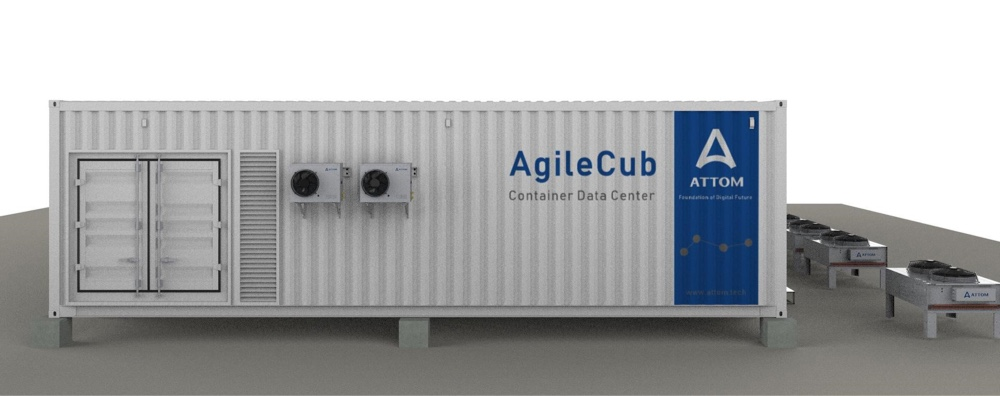
AgileCub:The completed Container Data Center includes the facility structure, IT equipment, Power infrastructure and cooling system. all section are built and integrated under tightly controlled factory conditions by trained specialists. When serving AI devices, SmoothAir RDHx is a suitable temperature control system that is installed directly at the back door of the rack, which draws the heat from the rack and converts it into cold air to maintain a constant temperature and humidity throughout the entire IT space.
Core Subsystems
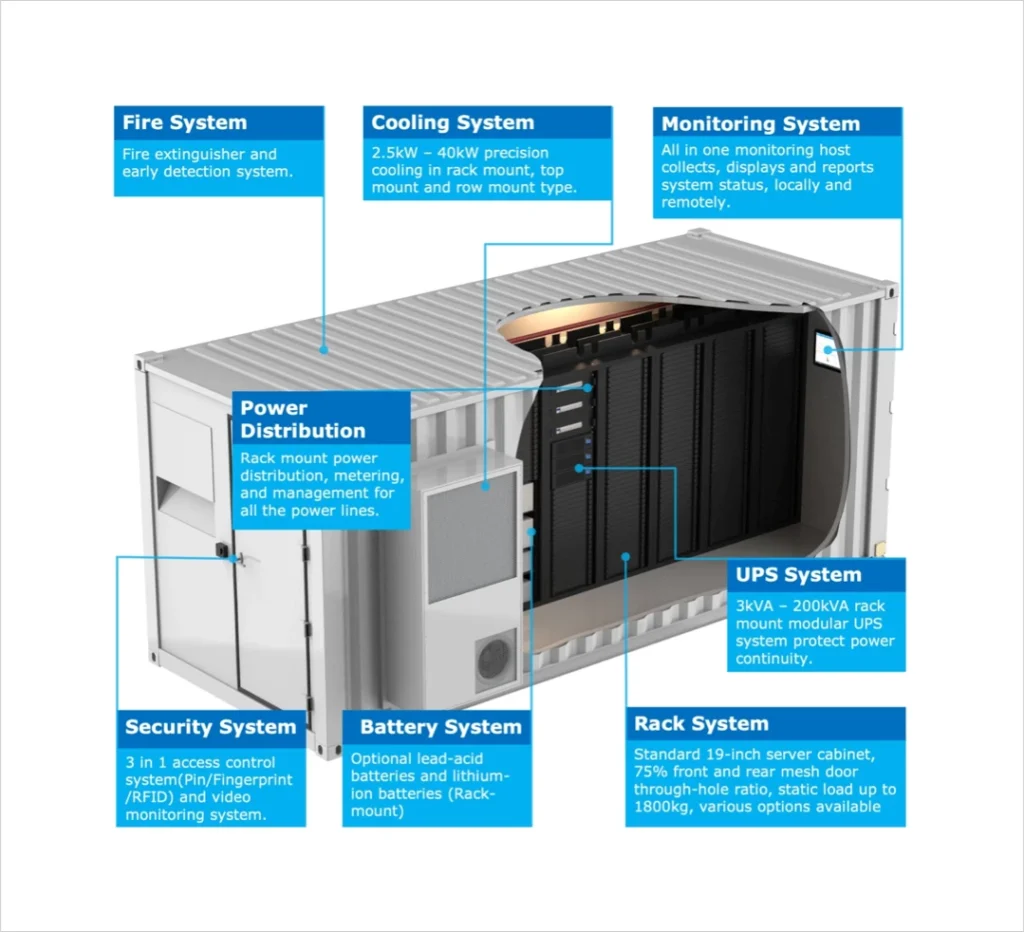
Although configurations vary depending on application requirements and vendor design, most container data centers include the following subsystems:
Structural and Mechanical Design
The container enclosure is reinforced to support equipment loads, airflow paths, and environmental protection requirements. Mechanical design focuses on airflow organization, thermal isolation, and maintainability within a limited internal space.
Power Infrastructure
Typical power architecture includes utility or generator input, UPS systems, battery backup, PDUs, and grounding systems. Redundancy levels are selected based on availability targets, cost constraints, and space limitations.
Cooling Systems
Cooling solutions commonly include DX units, in-row cooling, rear-door heat exchangers, or other hybrid configurations. The appropriate architecture depends on IT load, rack density, ambient conditions, and heat-rejection requirements. Due to the compact footprint, airflow management and temperature distribution must be carefully engineered to avoid localized hotspots and uneven thermal gradients.
For deployments in demanding climates or higher-density environments, see ATTOM’s Precision Cooling for Hot Climates solutions.
IT and Network Equipment
High-density racks, storage systems, and network switches are pre-installed according to airflow and power distribution layouts. Equipment density is often higher than in conventional data halls, which influences cooling and maintenance strategies.
Monitoring and Security
Environmental monitoring, remote management, and physical security systems are typically integrated as standard features, reflecting the fact that container data centers are frequently deployed in remote or lightly staffed locations.
Operational Advantages and Engineering Trade-offs
Deployment Speed
Container data centers can be delivered and commissioned significantly faster than conventional facilities, with typical timelines ranging from several weeks to a few months. However, this speed depends on early design finalization and factory-level integration, which reduces flexibility during later project stages.
Scalability
The modular architecture supports incremental expansion through the addition of container units. In practice, scalability is constrained less by the container design itself and more by site-level factors such as power availability, network connectivity, and physical space.
Space Utilization
Containerized systems achieve high equipment density within a compact footprint, making them suitable for edge deployments and space-constrained sites. The trade-off is reduced maintenance space compared with traditional data center halls.
Energy Efficiency
Energy performance varies depending on cooling design and operating conditions. While container data centers can achieve acceptable efficiency levels, their compact form factor limits the application of large-scale cooling optimizations commonly used in hyperscale facilities.
Reliability and Availability
Reliability depends on redundancy design and component selection. Higher availability levels can be achieved, but often at the cost of reduced usable IT space and increased system complexity.
Container Data Center vs Traditional Data Center
| Comparison Factor | Container Data Center | Traditional Data Center |
|---|---|---|
| Deployment | Typically weeks to months, depending on scope and site readiness | Typically requires a longer construction and commissioning cycle |
| Construction Model | Factory-prefabricated and integrated | Primarily constructed and integrated on site |
| Scalability | Add or connect additional modules as capacity grows | Expand the existing building or construct additional facility space |
| Location | Well suited to remote, edge, constrained, or temporary sites | Typically designed for permanent, purpose-built facilities |
| Civil Construction | Reduced building construction requirements, depending on site conditions | Greater site development and building infrastructure requirements |
| Mobility | Can be transported or redeployed when the design and site allow | Generally fixed to the original facility |
| Design Flexibility | More constrained by enclosure dimensions and transport requirements | Greater freedom for facility layout and architectural design |
| Maintenance Space | More limited and requires careful equipment layout | Generally provides more dedicated service and maintenance space |
| Expansion Model | Modular capacity expansion | Facility-level expansion |
| Best-Fit Applications | Edge computing, remote sites, rapid capacity expansion, disaster recovery, and specialized deployments | Large-scale permanent facilities and applications requiring extensive infrastructure flexibility |
Container Data Center Applications and Use Cases
In real-world deployments, container data centers are commonly used in:
- AI and High-Density Computing
- Edge computing environments
- Temporary or rapidly deployed IT infrastructure
- Disaster recovery and backup sites
- Remote industrial or telecom locations
- Incremental capacity expansion for existing data centers
These scenarios reflect a practical balance between flexibility, deployment speed, and infrastructure investment rather than a universal replacement for traditional data center facilities.
Engineering Considerations for Container Data Centers
From an infrastructure design standpoint, container data centers should be viewed as standardized, modular infrastructure components rather than standalone facilities. Their primary value lies in predictable deployment, controlled scalability, and integration with broader data center ecosystems.
Successful implementation depends on alignment between container design, site conditions, power capacity, and operational requirements. Without this alignment, the benefits of modularity can be offset by integration complexity and operational constraints.
Key Specifications to Define for a Container Data Center
Designing a container data center requires more than selecting the enclosure size. The technical specification should define the IT, power, cooling, environmental, and operational requirements before system integration begins.
| Specification | Key Considerations |
|---|---|
| Container Size | 20-foot, 40-foot, or custom enclosure based on available space, equipment layout, and transport requirements |
| IT Load | Total IT capacity, expected growth, and target power demand |
| Rack Density | Number of racks and expected kW per rack, particularly for high-density or AI workloads |
| Power Infrastructure | Utility or generator input, UPS capacity, PDU configuration, battery backup, and redundancy requirements |
| Cooling Architecture | DX, precision air cooling, in-row cooling, rear-door heat exchangers, or liquid cooling based on thermal load |
| Redundancy | Required availability level and N, N+1, or 2N architecture where applicable |
| Environmental Conditions | Ambient temperature, humidity, dust, corrosion, altitude, and other site-specific conditions |
| Fire Protection | Fire detection, suppression, compartmentation, and applicable local requirements |
| Monitoring & DCIM | Environmental monitoring, power monitoring, equipment status, alarms, and remote management |
| Network Connectivity | Fiber, copper, carrier connectivity, network equipment, and physical routing requirements |
| Physical Security | Access control, surveillance, intrusion protection, and enclosure protection |
| Site & Deployment Requirements | Foundation, transportation access, lifting, utility connections, commissioning, and maintenance access |
| Compliance & Testing | Applicable electrical, fire, structural, environmental, and local regulatory requirements, together with factory and site acceptance testing |
Container Data Center Real-World Applications
The following projects demonstrate how container data centers are applied in different industries where rapid deployment, reliability, and modular scalability are critical requirements.
Education: MSU Philippines
Mindanao State University (MSU) in the Philippines deployed an AgileCub container data center to enhance campus IT infrastructure with a fast, reliable, and scalable solution. The prefabricated container data center integrates redundant power, efficient cooling, environmental monitoring, and DCIM management, providing enterprise-level reliability in a hot and humid environment. This project demonstrates how container data centers enable rapid deployment and flexible infrastructure expansion for education and remote applications.
View the MSU Philippines Case Study →
Banking: Central Bank of El Salvador
The Central Reserve Bank of El Salvador deployed an AgileCub container data center solution to support its mission-critical financial infrastructure with enhanced security and reliability. The customized solution integrates high-level physical protection, redundant power systems, precision cooling, fire protection, and intelligent DCIM monitoring. This project demonstrates how container data centers can deliver secure, resilient, and rapidly deployable infrastructure for financial institutions with strict operational requirements.
View the Central Reserve Bank of El Salvador Case Study →
Related Resources
How to Build a High-Efficiency Container Data Center
Explore the key engineering considerations behind designing and deploying high-efficiency container data centers, including power architecture, cooling optimization, rack layout, monitoring systems, and deployment strategies.
AI Data Center: A Complete Guide to AI Infrastructure, Power, Cooling, and Design
Learn how AI data centers are designed for high-density computing, including power, liquid cooling, thermal management, monitoring, modular infrastructure and deployment considerations.
Container Data Center Solutions by ATTOM
ATTOM’s AgileCub 2.0 Container Data Center integrates IT space, power distribution, cooling, monitoring, and security within a prefabricated modular platform. Available in 20-foot and 40-foot configurations, AgileCub 2.0 is designed for edge computing, enterprise expansion, remote deployments, and other applications requiring rapid, scalable infrastructure deployment.
Explore AgileCub 2.0 to review its rack capacity, cooling architecture, environmental protection, deployment capabilities, and available configurations.
Frequently Asked Questions About Container Data Centers
What is a container data center?
A container data center is a prefabricated modular data center built inside a standardized container enclosure. It integrates critical infrastructure such as IT racks, power distribution, cooling systems, fire protection, security, and monitoring into a factory-engineered module. Unlike traditional data centers that require long construction cycles, container data centers can be manufactured, transported, and deployed quickly for edge computing, remote sites, and capacity expansion.
How does a container data center work?
A container data center works by integrating all essential data center subsystems into a compact, transportable structure. Power systems provide reliable energy distribution, cooling systems maintain optimal operating temperatures, and monitoring platforms manage performance and environmental conditions. After factory assembly and testing, the containerized module can be delivered and connected to local power and network infrastructure for rapid deployment.
What are the benefits of a container data center?
Container data centers provide several advantages, including faster deployment, modular scalability, reduced construction requirements, and flexible installation locations. They are ideal for organizations that need additional computing capacity without building a permanent facility. Other benefits include factory-controlled quality, improved deployment efficiency, and the ability to support edge computing, disaster recovery, and specialized infrastructure needs.
How much does a container data center cost?
The cost of a container data center depends on factors such as container size, IT capacity, power requirements, cooling technology, redundancy level, security features, and customization requirements. Compared with traditional data center construction, containerized solutions can reduce upfront infrastructure costs by minimizing civil construction and shortening deployment time. A detailed cost assessment requires evaluating the specific application and engineering requirements.
Can a container data center support AI workloads?
Yes. Modern container data centers can support AI workloads by integrating high-density power systems, advanced cooling solutions, and scalable IT infrastructure. For AI applications that require high-performance GPUs, solutions may include precision cooling, liquid cooling technologies, and optimized power distribution. This makes container data centers suitable for AI inference, edge AI, and distributed computing environments.
What is the difference between a modular data center and a container data center?
A modular data center is a broader concept that refers to prefabricated, scalable data center components, while a container data center is a specific type of modular data center built within a standardized container structure. Container data centers emphasize mobility and rapid deployment, making them suitable for edge locations and temporary capacity needs. Modular data centers may also include larger prefabricated buildings or dedicated modules designed for permanent installations.
What are the main components of a container data center?
A container data center consists of several integrated subsystems designed to provide complete data center functionality within a prefabricated enclosure. The main components include IT racks for servers and networking equipment, power distribution systems, cooling systems, fire protection, security systems, and intelligent monitoring platforms such as DCIM.
These components are factory-integrated and tested before deployment, enabling faster installation, reliable operation, and flexible scalability for edge computing, enterprise expansion, and remote infrastructure applications.
Related Data Center Infrastructure Topics
- Modular Data Center
- Edge Data Center
- Prefabricated Data Center
- Micro Data Center
- AI Data Center
- Edge Computing
- Liquid Cooling for Data Centers
- DCIM
For organizations evaluating distributed computing infrastructure, these topics should be considered as connected parts of the broader data center infrastructure architecture.