Prefabricated Data Centers: Types, Architecture, Benefits, and Solutions
Prefabricated data centers are data center infrastructure systems that are engineered, assembled, and tested in a controlled manufacturing environment before being transported to the deployment site. Instead of completing most infrastructure work sequentially onsite, prefabrication moves a significant portion of integration and testing into the factory.
A prefabricated data center can include IT space, power distribution, cooling, monitoring, security, and other supporting infrastructure. Depending on the project, the system may be delivered as a complete data center module or as multiple prefabricated modules that are connected onsite.
The main value of prefabrication is not simply faster construction. It changes how data center infrastructure is engineered, manufactured, tested, delivered, and expanded.
What Is a Prefabricated Data Center?
A prefabricated data center is a data center system in which major infrastructure assemblies are pre-engineered, factory-integrated, and tested before being delivered to the final site.
The term describes a method of delivering infrastructure, rather than a single physical form.
Prefabricated data centers may be built as:
- Containerized data centers
- Skid-mounted modules
- Enclosed modular systems
- Rack-level or micro data centers
- Larger modular data center blocks
- Combinations of prefabricated power, cooling, and IT modules
A prefabricated system may therefore be compact enough for an edge deployment or large enough to form part of a multi-module data center campus.
Prefabricated vs. Modular vs. Containerized Data Centers
These terms are closely related but should not be treated as interchangeable.
Prefabricated describes the manufacturing and integration approach: infrastructure is assembled and tested offsite before deployment.
Modular describes the architecture: the data center is divided into standardized or repeatable modules that can be deployed, combined, or expanded according to capacity requirements.
Containerized describes a physical form factor, typically using a container or enclosure to house IT and infrastructure systems.
A data center can therefore be modular without being containerized, and a containerized system can also be prefabricated. In many modern deployments, the three approaches are combined.
How Prefabricated Data Centers Work
The main difference between prefabricated and conventional construction is where the integration work takes place.
In a traditional data center, many electrical, mechanical, cooling, cabling, and infrastructure activities are completed sequentially at the project site. Prefabrication moves a significant portion of this work into a controlled factory environment.
A typical deployment process includes:
- Engineering and configuration — Define IT capacity, power, cooling, physical dimensions, redundancy, environmental conditions, and site requirements.
- Factory manufacturing — Build the structural and infrastructure modules under controlled conditions.
- System integration — Integrate power, cooling, racks, monitoring, cabling, and other specified systems.
- Factory testing — Test equipment and integrated systems before shipment.
- Site preparation — Complete foundations, utilities, external power, network connections, and other site-dependent work.
- Transportation and installation — Deliver the modules and position them at the deployment site.
- Site integration and commissioning — Connect power, cooling, network, and control interfaces and complete site-level testing.
The factory and site activities can proceed in parallel, which is one of the main reasons prefabricated construction can shorten the overall deployment cycle.
Main Components of a Prefabricated Data Center
The exact configuration depends on the workload and deployment model, but most prefabricated data centers integrate several infrastructure layers.
IT Infrastructure
The IT layer provides the physical environment for servers, storage, networking equipment, and other computing systems.
For conventional enterprise workloads, air-cooled racks may be sufficient. Higher-density AI and HPC deployments may require liquid cooling or a hybrid thermal architecture.
Rack density, available floor space, cable routing, service access, and future expansion should therefore be considered during the initial engineering stage rather than after the module has been manufactured.
Critical Power Infrastructure
Power infrastructure typically includes some combination of:
- UPS systems
- Power distribution
- PDUs
- Switchgear
- Backup power interfaces
- Monitoring and control systems
The power architecture must be matched to the IT load and required availability level. Prefabrication allows much of this equipment to be integrated and tested before shipment, reducing the amount of electrical assembly required onsite.
Cooling Infrastructure
Cooling is one of the most important engineering considerations because the required thermal architecture changes significantly with IT density.
Prefabricated data centers can be configured with:
- Precision air cooling
- In-row or rack-level cooling
- Rear-door heat exchangers
- Direct-to-chip liquid cooling
- Immersion cooling
- Liquid cooling and Hybrid air
For AI and HPC environments, the cooling system should be designed together with rack density and power distribution. Increasing IT power without providing an appropriate heat-rejection path can create a bottleneck even when sufficient electrical capacity is available.
Monitoring and Management
Monitoring systems provide visibility into infrastructure conditions such as:
- Power consumption
- Temperature
- Humidity
- Equipment status
- Environmental conditions
- Cooling performance
DCIM and related monitoring systems can connect these measurements to centralized operational workflows, helping operators identify abnormal conditions and manage distributed infrastructure.
Security and Supporting Infrastructure
Depending on the application, prefabricated systems may also integrate physical security, fire protection, environmental monitoring, structured cabling, access control, and other supporting infrastructure.
The objective is to move as much repeatable integration as practical into the factory while leaving site-dependent work for the deployment location.
Types of Prefabricated Data Centers
Prefabricated data centers can be classified by their physical form, functional scope, and degree of factory integration.
Containerized Prefabricated Data Centers
Containerized systems use an enclosed structure, often based on a standardized container form factor, to house IT and infrastructure equipment.
They are useful when deployment speed, transportation, and distributed capacity are important considerations.
Typical applications include edge computing, telecom infrastructure, remote locations, temporary capacity, and distributed AI workloads.
Rack-Level and Micro Data Centers
Rack-level and micro data centers integrate critical infrastructure into a compact footprint around one or more IT racks.
They are particularly useful when computing capacity needs to be deployed close to users, machines, sensors, or business operations.
Because the physical footprint is limited, power density, cooling capacity, service access, and environmental protection become important design parameters.
Modular Data Center Systems
Larger modular systems use multiple repeatable infrastructure blocks to create data center capacity.
A project may begin with a smaller number of modules and expand as demand increases. This approach can reduce the need to build the full future capacity before the workload is available.
Modular expansion is particularly relevant to enterprise infrastructure, edge deployments, cloud capacity, and AI infrastructure where future demand can be difficult to forecast precisely.
Prefabricated Power and Cooling Modules
Not every project requires a fully prefabricated data center.
Some deployments use prefabricated electrical or mechanical modules while the remaining facility is constructed using conventional methods. This hybrid approach can move the most complex or repetitive infrastructure work into the factory without requiring the entire facility to be factory-built.
Why Use Prefabricated Data Centers?
The benefits of prefabrication come primarily from moving repetitive and integration-intensive work into a controlled manufacturing environment.
Faster Deployment
Factory manufacturing can take place while site preparation is underway.
This parallel workflow reduces the amount of infrastructure work that needs to be completed sequentially at the deployment location. It can be particularly valuable when organizations need new computing capacity within a defined business or infrastructure schedule.
Actual deployment time still depends on site conditions, permitting, transportation, utility connections, commissioning, and project complexity.
More Consistent Manufacturing and Testing
Factory production provides a controlled environment for assembly, wiring, integration, and testing.
Repeatable manufacturing processes can reduce variations that are more difficult to control when infrastructure is assembled entirely onsite.
Factory testing can also identify integration problems before equipment reaches the final deployment location.
Scalable Capacity
Modular prefabricated architectures allow capacity to be deployed in stages.
Instead of building the entire future capacity at the beginning of a project, organizations can deploy an initial configuration and add modules as requirements develop.
This approach is particularly useful when future IT demand is uncertain or when infrastructure needs to expand across multiple locations.
Reduced Onsite Construction Complexity
Prefabrication does not eliminate site work, but it can reduce the amount of assembly and integration required onsite.
The site still needs appropriate foundations, utilities, electrical connections, network infrastructure, and other project-specific infrastructure.
The difference is that a larger portion of the data center system arrives onsite as an engineered and integrated assembly rather than as individual components requiring extensive field installation.
Repeatable Deployment
For organizations deploying infrastructure across multiple locations, a standardized prefabricated architecture can provide a repeatable deployment model.
The same engineering approach can be adapted to different sites while allowing capacity, cooling, power, and enclosure configurations to change according to local requirements.
This is particularly useful for edge computing, telecom, distributed enterprise infrastructure, and geographically distributed AI deployments.
Prefabricated Data Centers for AI and High-Density Computing
AI infrastructure is changing the requirements placed on data center power and cooling systems.
GPU-intensive workloads can create substantially higher rack power densities than conventional enterprise workloads. As density increases, cooling becomes a system-level design constraint rather than simply an HVAC selection.
Prefabricated infrastructure can help address these requirements by integrating:
- High-density rack infrastructure
- High-capacity power distribution
- Liquid cooling systems
- Cooling distribution infrastructure
- Monitoring and control
- Repeatable modular deployment
Liquid cooling can be implemented through different architectures, including direct-to-chip cooling, rear-door heat exchangers, and immersion cooling. The appropriate approach depends on rack density, server configuration, coolant requirements, facility architecture, and operating conditions.
For AI deployments, the key advantage of prefabrication is therefore not simply that the infrastructure is built in a factory. It is that power, cooling, rack infrastructure, and monitoring can be engineered as an integrated system before deployment.
Prefabricated Data Centers vs. Traditional Data Centers
| Factor | Prefabricated Data Center | Traditional Site-Built Data Center |
|---|---|---|
| Manufacturing | Significant factory assembly | Primarily onsite construction |
| Integration | Factory integration before delivery | More field integration |
| Testing | Factory testing can be performed before shipment | More testing occurs onsite |
| Deployment | Modules can be installed and connected onsite | Infrastructure is built progressively onsite |
| Scalability | Additional modules can be added depending on architecture | Expansion may require larger facility modifications |
| Standardization | Higher potential for repeatable configurations | More project-specific construction |
| Site dependency | Still requires site preparation and utility connections | Highly dependent on onsite construction |
| Customization | Configurable within the module architecture | Broad customization possible |
| Best fit | Rapid, repeatable, distributed or phased deployment | Large permanent facilities and highly customized builds |
Prefabrication is not automatically better for every project. Large hyperscale facilities, highly customized campuses, and projects with unusual site conditions may still benefit from conventional construction or a hybrid approach.
The right choice depends on deployment schedule, capacity requirements, site constraints, required customization, logistics, and lifecycle strategy.
Engineering Considerations When Selecting a Prefabricated Data Center
A prefabricated system should be evaluated as an infrastructure platform rather than simply as a factory-built enclosure.
Key considerations include:
IT load and rack density: Define the current and expected future IT load before selecting power and cooling capacity.
Power architecture: Determine voltage, UPS requirements, distribution architecture, redundancy, backup power interfaces, and available utility capacity.
Cooling architecture: Match the thermal solution to rack density, climate, heat rejection requirements, and the selected server platform.
Site conditions: Evaluate foundation requirements, environmental exposure, transportation access, lifting requirements, utility connections, and local regulations.
Expansion strategy: Determine whether additional modules can be added without major redesign of power, cooling, networking, or physical infrastructure.
Maintenance access: Factory integration should not compromise access to equipment that requires inspection, replacement, or service.
Commissioning: Confirm how factory testing, site acceptance testing, and integrated system commissioning will be performed.
The goal is not to maximize factory prefabrication. The goal is to determine which parts of the data center benefit most from standardized factory integration.
ATTOM Prefabricated Data Center Solutions
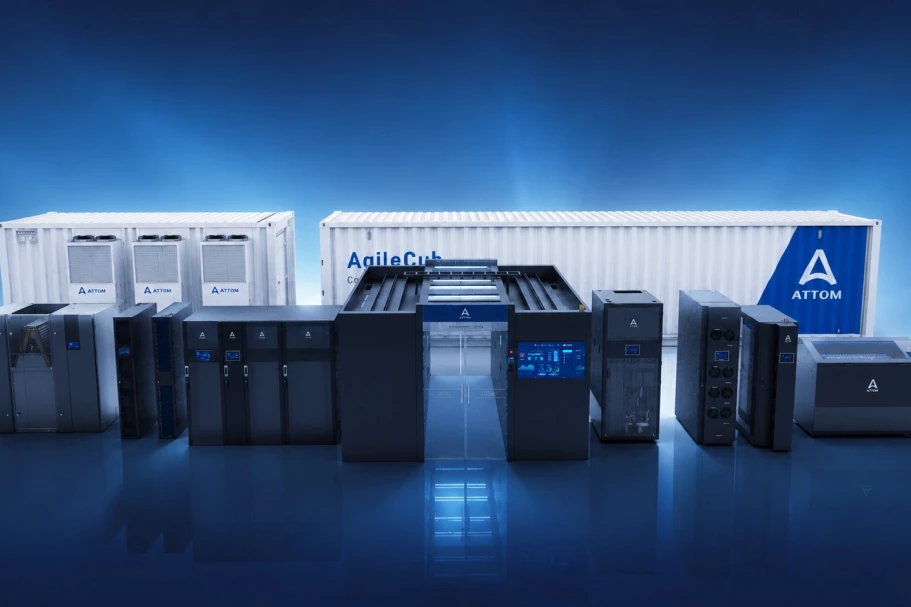
ATTOM provides a portfolio of prefabricated and modular data center architectures covering different deployment scales and workloads.
The portfolio includes:
- AgileCore — AI-ready prefabricated modular data center architecture designed for high-density computing and advanced cooling.
- AgileRax — Rack-level micro data center architecture for compact and distributed deployments.
- AgileCub — Containerized data center architecture for modular and mobile infrastructure deployment.
- AgileMod — Containment modular data center architecture.
- AgileHub — Shelter-based modular data center architecture.
ATTOM also integrates supporting technologies including precision cooling, liquid cooling, critical power, monitoring, and IT rack infrastructure.
For high-density AI applications, AgileCore can be configured with liquid cooling technologies including direct-to-chip cooling, rear-door heat exchangers, and immersion cooling, depending on project requirements.
The broader architecture is designed around the integration of power, cooling, IT infrastructure, and monitoring rather than treating each subsystem as an isolated component.
Frequently Asked Questions About Prefabricated Data Centers
What is a prefabricated data center?
A prefabricated data center is a data center system in which major infrastructure assemblies are engineered, integrated, and tested in a factory before being transported and installed at the deployment site.
Are prefabricated and modular data centers the same?
Not exactly. Prefabrication describes how infrastructure is manufactured and integrated, while modular describes how the infrastructure is structured into repeatable units. The two approaches are often combined.
Are containerized data centers prefabricated?
They can be. A containerized data center describes the physical enclosure or form factor. When the equipment is factory-integrated and tested before shipment, it can also be considered a prefabricated data center.
Can prefabricated data centers support AI workloads?
Yes. Prefabricated data centers can be engineered for high-density AI workloads by integrating appropriate power distribution, rack infrastructure, cooling, and monitoring. Depending on rack density and server configuration, liquid cooling may be required.
Are prefabricated data centers scalable?
Many prefabricated modular architectures are designed for phased expansion. Additional modules can be added as capacity requirements grow, although the expansion strategy should be defined during the initial engineering stage.
Do prefabricated data centers eliminate onsite construction?
No. Site preparation, foundations, utility connections, transportation, module installation, interconnections, and commissioning are still required. Prefabrication moves a larger portion of manufacturing and integration work from the site to the factory.
What applications are suitable for prefabricated data centers?
Common applications include enterprise infrastructure, edge computing, telecommunications, distributed computing, AI infrastructure, high-performance computing, cloud infrastructure, and phased capacity expansion.
Conclusion
Prefabricated data centers represent a manufacturing-led approach to data center deployment. By moving engineering, assembly, integration, and testing into a controlled factory environment, they can reduce onsite complexity and support faster, more repeatable infrastructure deployment.
The technology is not limited to containerized facilities. Prefabrication can be applied to rack-level systems, modular data center blocks, power and cooling modules, and larger integrated infrastructure architectures.
For modern deployments, the most important question is not whether a data center is simply “prefabricated.” It is which parts of the power, cooling, IT, and monitoring architecture should be factory-integrated to achieve the required deployment speed, reliability, scalability, and lifecycle performance.
Related Data Center Infrastructure Topics
- AI Data Center
- Micro Data Center
- Edge Data Center
- Container Data Center
- Edge Computing
- Liquid Cooling
- DCIM
For organizations evaluating distributed computing infrastructure, these topics should be considered as connected parts of the broader data center infrastructure architecture.