Immersion Cooling for Data Center : Advantages and deployment Guide
For more than a decade, air cooling has been the default approach for data centers. It is mature, reliable, well understood, and has supported large-scale growth from traditional enterprise IT to cloud computing. However, as computing paradigms evolve—higher-power chips, more centralized workloads, and denser deployment models—cooling has gradually shifted from a supporting system to a design constraint.
Against this backdrop, immersion cooling is no longer just a laboratory concept. It is increasingly being evaluated and deployed as a liquid cooling approach for high-density data center environments, particularly where conventional air cooling becomes difficult to scale.
Immersion cooling is one of the major technologies within the broader liquid cooling landscape. Unlike direct-to-chip cooling, which transfers heat through cold plates attached to high-power processors, immersion cooling places compatible IT equipment directly in a non-conductive dielectric fluid.
For operators evaluating immersion cooling for data centers, the decision is therefore not simply whether immersion provides higher heat-transfer capability. Server compatibility, facility infrastructure, fluid management, maintenance procedures, operating requirements, and long-term deployment plans all need to be considered.
See ATTOM’s Liquid Cooling for Data Centers guide →
What Is Immersion Cooling?
Immersion cooling is a liquid cooling technology in which servers or compatible IT components operate while fully immersed in a non-conductive dielectric cooling fluid.
Heat generated by processors, memory, power components, and other IT equipment transfers directly into the surrounding liquid. The heated fluid is then circulated or managed through a heat-rejection system before returning to the equipment.
The most significant difference from traditional air cooling is that heat no longer relies primarily on air as the transfer medium.
As a result, immersion cooling can significantly reduce dependence on:
- Server fans
- High-volume airflow
- Hot and cold aisle management
- Air containment structures
- Room-level airflow paths
In simple terms, air cooling moves heat through air, while immersion cooling transfers heat directly from compatible IT equipment into a surrounding dielectric liquid.
The technology is particularly relevant to high-density computing environments where thermal loads are becoming difficult to manage through airflow alone.
For a concise technical definition, see ATTOM’s Immersion Cooling Glossary →.
How Does Immersion Cooling Work?
In a typical immersion cooling system, servers or compute equipment are installed in dedicated tanks or enclosures and operate fully submerged in dielectric fluid.
Key heat-generating components—including chips, memory, and power components—transfer heat directly to the surrounding liquid during operation.
The heat is then removed through one of two primary approaches:
Single-Phase Immersion Cooling
In a single-phase system, the dielectric coolant remains in liquid form throughout the cooling cycle.
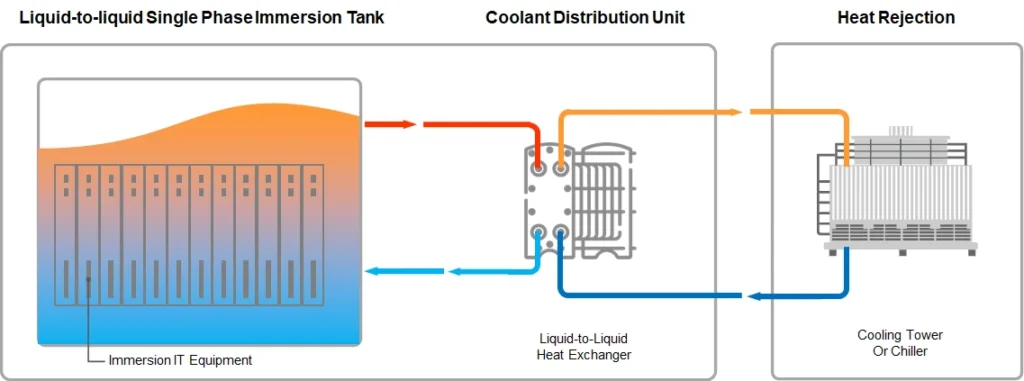
The heated coolant is circulated to a heat exchanger, where heat is transferred to a secondary cooling loop such as chilled water or another facility cooling system. The cooled dielectric fluid then returns to the immersion tank.
The basic thermal path is:
IT equipment → dielectric fluid → heat exchanger → facility cooling loop → heat rejection → cooled fluid
Single-phase systems generally have a relatively straightforward thermal cycle and can provide predictable operation for sustained high-density workloads.
Two-Phase Immersion Cooling
In a two-phase system, the dielectric coolant undergoes a phase change as it absorbs heat.
The fluid boils at the heat source, producing vapor. The vapor rises within the enclosure and is subsequently condensed, returning the fluid to its liquid state.
The phase-change process uses latent heat to remove thermal energy and can provide high heat-transfer capability.
However, two-phase systems introduce additional engineering requirements involving:
- Fluid selection
- Materials compatibility
- Sealing
- Condensation
- Pressure and thermal management
- Fluid control
- Operational procedures
For this reason, two-phase immersion should not automatically be considered a better choice than single-phase immersion. The appropriate architecture depends on the workload, thermal requirements, facility constraints, and operational capabilities.
Main Types of Immersion Cooling
Single-phase and two-phase immersion cooling are the two primary system architectures.
| Category | Single-Phase Immersion Cooling | Two-Phase Immersion Cooling |
|---|---|---|
| Cooling principle | Dielectric fluid remains liquid and circulates through a heat-rejection loop | Dielectric fluid changes phase and returns through condensation |
| Heat-transfer mechanism | Sensible heat transfer | Latent heat from phase change |
| System complexity | Relatively straightforward | Higher |
| Fluid management | More conventional circulation and filtration requirements | More demanding fluid and vapor management |
| Maintenance | More familiar liquid-system procedures | More specialized |
| Best-fit scenarios | Production environments prioritizing stability and predictability | Extremely high-density or space-constrained workloads |
There is no absolute “better” option.
The optimal choice depends on project objectives, risk tolerance, equipment compatibility, facility design, maintenance capability, and long-term operating requirements.
4 Core Advantages of Immersion Cooling in Data Centers
Immersion cooling provides several potential advantages for high-density computing, but its value should always be evaluated at the complete system level.
1. More Direct and Efficient Heat Transfer
Liquids can transfer heat more effectively than air under appropriate system conditions.
With immersion cooling, heat generated by compatible IT components is transferred directly into the surrounding dielectric fluid rather than first moving through heatsinks, server airflow, and room air.
This shortens the thermal path and can provide greater thermal headroom for high-power computing workloads.
The advantage becomes particularly relevant as GPU and accelerator power increases and thermal loads become concentrated within fewer physical racks.
2. High Degree of Decoupling from Air Cooling Systems
Because immersion cooling does not rely primarily on data hall airflow, it can reduce dependence on traditional airflow-management infrastructure.
Potential benefits include:
- Reduced dependence on hot/cold aisle configurations
- Lower reliance on containment structures
- Reduced server fan requirements
- Less dependence on room-level supply and return airflow
- Greater flexibility in high-density equipment placement
This does not mean that the entire facility becomes independent of environmental control. Facility heat rejection, power infrastructure, monitoring, and maintenance still need to be designed around the immersion system.
3. Potential for Overall Energy Efficiency Optimization
Immersion cooling can significantly reduce or eliminate server fan requirements because heat is transferred directly into the dielectric fluid.
This changes the energy profile of the IT and cooling infrastructure.
However, immersion cooling does not automatically guarantee lower total energy consumption.
Pumps, heat exchangers, cooling equipment, controls, and facility heat rejection all consume energy. The actual efficiency outcome therefore depends on the complete system architecture.
For broader data center efficiency considerations, see ATTOM’s PUE in Data Centers guide →.
4. Support for High-Density Computing
Immersion cooling can support high-density computing by moving heat directly from IT equipment into liquid.
This makes it particularly relevant to:
- AI training infrastructure
- GPU clusters
- High-performance computing
- Scientific computing
- Specialized high-density deployments
The technology should nevertheless be selected based on the actual thermal and operational requirements rather than density alone.
Immersion Cooling vs. Direct-to-Chip Cooling
Immersion cooling and direct-to-chip cooling are both liquid cooling technologies, but they capture heat differently.
Direct-to-chip cooling attaches cold plates directly to high-power components such as CPUs and GPUs. Immersion cooling instead places compatible IT equipment directly into dielectric fluid.
| Factor | Direct-to-Chip Cooling | Immersion Cooling |
|---|---|---|
| Heat capture | Cold plates attached to high-power components | Dielectric fluid surrounds compatible IT equipment |
| Contact with electronics | Coolant remains within a controlled cooling loop | Dielectric fluid directly contacts equipment |
| Server modification | Requires compatible cold plates and liquid interfaces | Requires immersion-compatible equipment and deployment procedures |
| Air cooling | Residual air cooling may still be required | Dependence on server airflow can be greatly reduced |
| Retrofit potential | Depends on server and facility configuration | Generally requires more significant deployment changes |
| Typical applications | AI, GPU, HPC, high-density racks | Specialized AI, HPC, and high-density deployments |
| Maintenance model | Similar to liquid-cooled rack/server maintenance | Requires immersion-specific handling and service procedures |
Neither technology is universally superior.
D2C is often attractive when operators want to retain conventional server architecture while applying liquid cooling directly to the highest-power components.
Immersion can be attractive when the deployment benefits from direct fluid contact with the equipment and reduced dependence on airflow.
For a deeper discussion of D2C architecture:
Direct-to-Chip Liquid Cooling: Working Principle, Architecture and Engineering Guide →
Immersion Cooling for AI and HPC
AI and HPC workloads are among the strongest use cases for advanced liquid cooling because they can concentrate substantial computing power and thermal output into a limited physical footprint.
Immersion cooling can support these environments by:
- Removing heat directly from IT equipment
- Reducing reliance on server airflow
- Supporting high thermal loads
- Providing greater flexibility in high-density deployments
- Reducing the need to scale room airflow in proportion to IT power
However, AI and HPC workloads also change rapidly.
GPU generations, server architectures, rack densities, and workload utilization can all affect cooling requirements.
For this reason, an immersion cooling deployment should be designed around both current and projected compute density.
HPC Cooling: Technologies, Systems, and Design Considerations →
When Should a Data Center Consider Immersion Cooling?
Immersion cooling becomes more relevant when conventional cooling approaches are approaching their practical limits.
Operators should consider questions such as:
- How are workload power density and operating characteristics evolving?
- Are GPU or accelerator workloads becoming dominant?
- Has the existing cooling system become—or is it likely to become—a thermal bottleneck?
- Is airflow management becoming difficult at the required rack density?
- Does the facility need to support significantly higher compute density?
- How much modification can the IT equipment and facility tolerate?
- What is the data center’s expansion path over the next three to five years?
Immersion cooling should therefore be considered as part of a broader thermal-management strategy rather than selected solely because it offers high theoretical heat-transfer performance.
Immersion Cooling Deployment Considerations
The deployment approach differs significantly between new data centers and existing facilities.
New Data Center Deployment
A new data center provides greater freedom to integrate immersion cooling with the facility from the beginning.
The design should consider:
- Tank or enclosure layout
- IT equipment compatibility
- Power distribution
- Cooling loops
- Heat exchangers
- Heat-rejection equipment
- Monitoring and controls
- Maintenance access
- Service procedures
- Future expansion
Integrating these requirements during the design stage can reduce the need for later facility modifications.
Existing Data Center Deployment
Retrofit projects require a more constrained approach.
Existing facilities may have limitations involving:
- Available floor space
- Structural loading
- Power distribution
- Cooling-loop capacity
- Pipe routing
- Server compatibility
- Maintenance access
- Shutdown windows
- Existing air-cooling infrastructure
For this reason, localized or phased deployment may be more practical than converting an entire data center to immersion cooling at once.
A phased approach can begin with selected high-density workloads while conventional air-cooled infrastructure continues to support other equipment.
Hardware Compatibility
Immersion cooling requires compatible IT equipment and components.
Before deployment, operators should evaluate:
- Server chassis compatibility
- CPU and GPU compatibility
- Memory and storage components
- Power supplies
- Cabling
- Materials compatibility
- Fluid compatibility
- Manufacturer support
- Warranty conditions
Not every conventional server is designed to operate in an immersion environment.
This makes hardware validation one of the most important early steps in an immersion cooling project.
Operations and Maintenance
Immersion cooling changes the physical maintenance model of a data center.
Technicians may need procedures for:
- Server removal and installation
- Fluid handling
- Tank or enclosure access
- Fluid filtration
- Fluid condition monitoring
- Component inspection
- Leak or containment response
- Cleaning and maintenance
- Equipment isolation
The maintenance process should be considered during system design rather than after installation.
Operational teams should also understand how immersion changes normal server service procedures.
Coolant Management
The dielectric fluid is a critical part of an immersion cooling system.
The selected fluid must be compatible with the IT equipment and the operating environment.
Important considerations include:
- Thermal characteristics
- Electrical properties
- Material compatibility
- Long-term stability
- Fluid contamination
- Filtration
- Handling procedures
- Replacement and disposal requirements
Fluid management should be treated as part of the overall reliability strategy.
The objective is not simply to select a fluid with high heat-transfer capability, but to maintain stable and predictable operation over the expected system lifetime.
Facility Integration
An immersion cooling system still needs to reject the heat absorbed by the dielectric fluid.
Depending on the architecture, this may involve:
- Heat exchangers
- Secondary cooling loops
- Chilled water
- Dry coolers
- Cooling towers
- Free-cooling systems
- Pumps and controls
The immersion system therefore remains connected to the broader facility infrastructure.
Power, cooling, monitoring, and maintenance should be considered as an integrated data center architecture.
ATTOM’s AI-ready modular infrastructure demonstrates this integrated approach, combining immersion cooling with other liquid cooling and facility systems.
Explore ATTOM AgileCore AI Modular Data Center →
Reliability and Risk Management
Immersion cooling does not inherently make a data center more or less reliable.
Reliability depends on:
- System architecture
- Component quality
- Fluid management
- Redundancy
- Monitoring
- Installation quality
- Maintenance procedures
- Operator training
A mature deployment should consider appropriate monitoring and fault-response mechanisms for the cooling loop and associated facility systems.
Operational procedures should define how abnormal conditions are detected, isolated, serviced, and restored.
The objective is to make immersion cooling part of the data center’s mission-critical infrastructure rather than treating it as a standalone technology experiment.
Immersion Cooling and Energy Efficiency
Immersion cooling can reduce the energy associated with server fans and large-scale airflow management.
However, energy efficiency should be evaluated across the entire system.
The assessment should include:
- IT fan power
- Pump power
- Heat exchanger performance
- Chiller or dry-cooler energy
- Cooling-loop efficiency
- Facility heat rejection
- Operating temperature
- Workload utilization
A system-level evaluation is more meaningful than comparing immersion cooling with air cooling based on a single component or theoretical heat-transfer value.
This is also why PUE should be treated as an overall facility metric rather than proof that one cooling technology is automatically more efficient.
Immersion Cooling for New Builds vs. Retrofits
The economics and engineering priorities differ between new construction and retrofit projects.
New Builds
New construction allows the immersion cooling architecture to be coordinated with:
- Rack and tank layout
- Power infrastructure
- Cooling infrastructure
- Heat rejection
- Structural requirements
- Monitoring
- Maintenance access
- Future capacity expansion
This provides the greatest freedom to optimize the complete thermal architecture.
Retrofits
Existing facilities require the immersion solution to work around infrastructure that may still be operational.
A phased deployment can reduce risk by applying immersion cooling first to the workloads where conventional air cooling has become the largest constraint.
This approach also allows operators to validate:
- Hardware compatibility
- Cooling performance
- Maintenance procedures
- Fluid management
- Operational workflows
before expanding the deployment.
How to Evaluate an Immersion Cooling Project
A practical evaluation can follow six steps.
1. Define the Workload
Identify:
- CPU/GPU configuration
- Compute utilization
- Rack density
- Thermal load
- Future workload growth
2. Evaluate Equipment Compatibility
Confirm that servers and critical components can operate in the selected immersion architecture.
3. Assess Facility Constraints
Review:
- Available space
- Structural capacity
- Power distribution
- Cooling infrastructure
- Heat rejection
- Maintenance access
4. Select the Immersion Architecture
Compare single-phase and two-phase systems according to:
- Thermal requirements
- System complexity
- Maintenance capability
- Fluid management
- Operational objectives
5. Define Reliability and Maintenance Requirements
Establish:
- Monitoring
- Redundancy
- Service procedures
- Fluid management
- Equipment isolation
- Fault-response procedures
6. Evaluate Long-Term Value
Consider:
- Rack density
- Cooling capacity
- Energy consumption
- Facility expansion
- Hardware refresh cycles
- Operational requirements
- Total cost of ownership
The best immersion cooling solution is therefore the one that fits the workload and facility—not necessarily the technology with the highest theoretical cooling capability.
ATTOM OceanCool Immersion Cooling
ATTOM’s OceanCool portfolio is designed for immersion liquid cooling applications in high-density computing environments.
The current OceanCool product documentation includes configurations ranging from single-rack systems to larger multi-rack systems, with different cooling capacities and rack-density configurations. Exact performance depends on the model, operating conditions, and cooling-water temperature.
OceanCool uses immersion cooling to transfer heat from IT equipment into a heat-conducting liquid, with heat then transferred through a liquid-to-liquid heat exchanger and rejected through cooling equipment.
For AI infrastructure, ATTOM also integrates OceanCool with its broader AgileCore AI modular data center architecture, where immersion cooling can be deployed alongside direct-to-chip and rear-door heat exchanger technologies according to workload and infrastructure requirements.
Explore ATTOM Immersion Liquid Cooling Solution →
Frequently Asked Questions
What is immersion cooling?
Immersion cooling is a liquid cooling technology in which compatible servers or IT components are submerged in a non-conductive dielectric fluid. The fluid absorbs heat directly from the equipment and transfers it to a heat-rejection system.
What are the main types of immersion cooling?
The two primary types are single-phase and two-phase immersion cooling. Single-phase systems keep the dielectric fluid in a liquid state, while two-phase systems use evaporation and condensation to transfer heat.
Is immersion cooling better than direct-to-chip cooling?
Not universally. Direct-to-chip cooling uses cold plates to remove heat from selected high-power components, while immersion cooling surrounds compatible IT equipment with dielectric fluid. The appropriate technology depends on workload, hardware compatibility, rack density, facility infrastructure, and operational requirements.
Is immersion cooling better than air cooling?
Immersion cooling can provide greater thermal capability and reduce dependence on airflow for high-density workloads. However, air cooling remains practical for many conventional workloads. The best approach depends on the thermal density and infrastructure requirements of the deployment.
Is immersion cooling suitable for AI data centers?
Yes. Immersion cooling can support high-density AI and GPU infrastructure where thermal loads and airflow requirements make conventional cooling difficult to scale.
Is immersion cooling suitable for HPC?
Yes. HPC is one of the applications where immersion cooling can provide value because high computational loads can create concentrated thermal requirements.
Can immersion cooling be deployed in an existing data center?
Yes, but retrofit deployment generally requires assessment of power infrastructure, cooling loops, physical space, server compatibility, structural requirements, and maintenance procedures. Localized or phased deployment can be more practical than full-facility conversion.
Does immersion cooling eliminate server fans?
Immersion cooling can significantly reduce or eliminate the need for conventional server fans because heat is transferred directly into the surrounding dielectric fluid. The exact hardware configuration depends on the immersion system and compatible IT equipment.
Does immersion cooling reduce PUE?
It can contribute to lower facility energy consumption, but immersion cooling does not automatically produce a lower PUE. Pumps, heat exchangers, chillers, dry coolers, and other facility systems must be considered as part of the complete cooling architecture.
Is immersion cooling safe?
Properly designed immersion cooling systems can operate safely when appropriate dielectric fluids, compatible equipment, containment, monitoring, maintenance procedures, and operational controls are used.
What is the difference between single-phase and two-phase immersion cooling?
Single-phase immersion keeps the cooling fluid in liquid form throughout the heat-transfer cycle. Two-phase immersion uses the fluid’s phase change to absorb and reject heat. Two-phase systems can provide high heat-transfer capability but generally involve greater system complexity.
Conclusion
Immersion cooling has become an important liquid cooling option as data centers move toward higher computing density.
Its primary advantage is the ability to transfer heat directly from compatible IT equipment into a dielectric fluid, reducing dependence on conventional airflow and providing greater thermal flexibility for high-density workloads.
Single-phase and two-phase architectures offer different trade-offs in system complexity, fluid management, thermal performance, and operational requirements.
The key decision is therefore not whether immersion cooling is inherently better than air cooling or direct-to-chip cooling. The more useful question is whether immersion provides the right balance of thermal capability, equipment compatibility, facility integration, maintenance requirements, reliability, and long-term scalability for a specific deployment.
For AI and HPC environments, immersion cooling can provide a practical path toward higher compute density when the associated IT and facility infrastructure is designed around the technology from the beginning.
For existing data centers, phased deployment can provide a more controlled way to introduce immersion cooling where conventional air cooling has reached its practical limits.
The strongest immersion cooling strategy starts with the workload, hardware, rack density, facility constraints, and long-term expansion plan—and then selects the cooling architecture that fits those requirements.