
What Is a Rear Door Heat Exchanger (RDHx)?
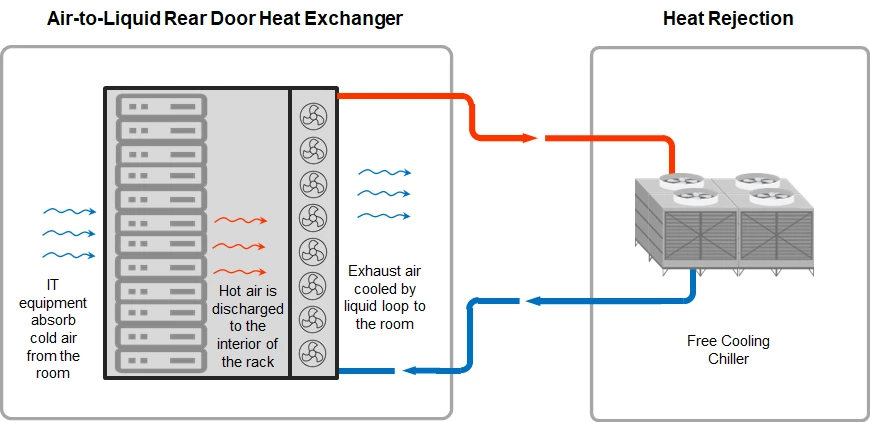
A Rear Door Heat Exchanger (RDHx) is a rack-level cooling system installed at the rear of a server cabinet. It removes heat from server exhaust air before that heat enters the data center room, using a liquid cooling circuit to transfer heat away from the rack.
Unlike room-level cooling systems such as CRAC and CRAH units, RDHx provides cooling closer to the heat source. This makes it particularly useful for high-density racks, retrofit projects, and data centers where conventional room-level air cooling is approaching its practical limits.
RDHx is also an important transition technology between conventional air cooling and more advanced liquid cooling approaches such as direct-to-chip cooling.
See ATTOM’s Liquid Cooling for Data Centers guide →
How Does a Rear Door Heat Exchanger Work?
An RDHx replaces or attaches to the rear door of a server rack.
Hot air generated by servers flows through the heat exchanger. A liquid cooling circuit removes heat from the air before the cooled air returns to the data center.
The basic thermal path is:
Server → hot exhaust air → RDHx → liquid cooling loop → facility heat rejection
Unlike direct-to-chip cooling, the liquid does not normally enter the server or contact IT components directly. Instead, heat is captured from the server’s exhaust air at the rack boundary.
This makes RDHx particularly attractive when operators want to increase cooling capacity without extensively modifying existing server hardware.
Why Use an RDHx?
The main value of RDHx is localized heat removal.
Traditional data centers rely heavily on room-level cooling to manage heat generated across many racks. As rack power increases, this approach can require more airflow, cooling capacity, and containment infrastructure.
RDHx moves part of the heat-removal process closer to the rack.
Key benefits include:
- Higher rack cooling capacity for selected high-density cabinets
- Reduced room-level cooling burden
- Lower dependence on large volumes of airflow
- Limited modification to server hardware
- Good retrofit potential
- Compatibility with hybrid air/liquid cooling environments
RDHx does not necessarily replace room-level cooling. In many deployments, it works together with CRAC or CRAH systems, with RDHx handling a larger share of the heat from high-density racks.
Types of Rear Door Heat Exchangers
RDHx systems are commonly divided into passive and active configurations.
| Type | Operating Principle | Typical Application |
|---|---|---|
| Passive RDHx | Uses existing server fans to move air through the heat exchanger | Low- to medium-density applications |
| Active RDHx | Uses additional fans to increase airflow through the heat exchanger | Higher-density racks and applications requiring greater cooling capacity |
Passive RDHx
Passive RDHx relies on the server’s existing fans to drive airflow through the heat exchanger.
Because it does not require additional fans in the rear door, it can reduce auxiliary fan energy and provide a relatively simple cooling architecture.
Its practical cooling capacity depends on server airflow and rack configuration.
Active RDHx
Active RDHx incorporates fans into the rear-door assembly to increase airflow through the heat exchanger.
This allows the system to support higher heat loads when server airflow alone is insufficient.
Active systems can therefore be useful for higher-density deployments, but their additional fans introduce additional power consumption and mechanical components.
RDHx vs. Direct-to-Chip Cooling
RDHx and direct-to-chip cooling are both liquid-based thermal management approaches, but they remove heat at different points.
| Factor | RDHx | Direct-to-Chip Cooling |
|---|---|---|
| Heat capture | Server exhaust air | CPU/GPU cold plates |
| Liquid contact with IT equipment | No | Within controlled cooling interfaces |
| Server modification | Usually limited | Requires compatible liquid interfaces |
| Retrofit potential | High | Depends on server and facility |
| Cooling density | Medium to high | High to very high |
| Typical use | Rack-level cooling and retrofit | AI, GPU, HPC, high-density computing |
RDHx is therefore particularly attractive when the objective is to increase rack cooling capacity while preserving the existing server architecture.
Direct-to-chip cooling becomes more appropriate when processor-level heat removal is required for very high-density CPU, GPU, or accelerator workloads.
Read ATTOM’s Direct-to-Chip Liquid Cooling guide →
When Is RDHx a Good Choice?
RDHx can be a practical solution when:
- Existing racks are becoming thermally constrained
- Conventional CRAC/CRAH capacity is reaching its limits
- Server modification should be minimized
- The facility already has chilled-water infrastructure
- Only selected racks require higher cooling capacity
- A phased transition toward liquid cooling is preferred
- AI or high-density workloads are being introduced into an existing facility
It can be particularly useful in mixed environments where conventional racks continue using air cooling while higher-density racks receive localized liquid-assisted cooling.
RDHx for Data Center Retrofits
One of the strongest applications for RDHx is data center retrofit.
A complete transition to direct-to-chip or immersion cooling may require significant changes to servers, rack infrastructure, piping, cooling systems, and operational procedures.
RDHx can provide a more incremental approach.
A typical transition path can be:
Existing air cooling → RDHx → hybrid liquid cooling → direct-to-chip cooling for selected high-density racks
This allows operators to increase cooling capacity where it is needed without replacing infrastructure that is still performing effectively.
For retrofit projects, the following should be evaluated before deployment:
- Rack layout
- Rear-door clearance
- Water supply and return connections
- Existing chilled-water capacity
- Pipe routing
- Cable management
- Maintenance access
- Leak detection
- CRAH/CRAC coordination
Key RDHx Deployment Considerations
Chilled Water Temperature
RDHx performance depends strongly on the temperature and flow of the cooling water.
The water temperature should be selected to provide sufficient heat removal while avoiding unnecessary condensation risk.
The operating conditions should therefore be coordinated with:
- Ambient temperature
- Relative humidity
- Dew point
- Server exhaust temperature
- Required cooling capacity
Integration With Existing Cooling Systems
RDHx normally operates alongside room-level cooling.
If the RDHx and CRAC/CRAH systems are not properly coordinated, the facility may experience inefficient airflow patterns, unnecessary cooling capacity, or unstable thermal conditions.
Integration with BMS or DCIM can improve monitoring and coordinated control.
Space and Cabling
Because RDHx equipment is installed at the rear of the rack, the design must account for:
- Water connections
- Pipe routing
- Flexible hoses
- Cable pathways
- Rear-door clearance
- Maintenance access
These requirements should be considered during rack and data center layout planning.
Leak and Condensation Management
Although RDHx does not normally introduce liquid directly into the server, it still contains a liquid cooling circuit.
Appropriate measures should include:
- Leak detection
- Proper insulation
- Reliable connectors
- Isolation mechanisms
- Inspection procedures
- Maintenance access
The cooling-water operating conditions should also be controlled to minimize condensation risk.
RDHx and Energy Efficiency
RDHx can reduce the amount of heat that must be removed by room-level cooling systems.
By capturing heat at the rack, it can reduce airflow requirements and allow cooling capacity to be concentrated where the thermal load is highest.
However, RDHx does not automatically guarantee lower energy consumption or lower PUE.
The overall result depends on:
- RDHx fan power
- Water pumping energy
- CRAC/CRAH operation
- Chiller efficiency
- Cooling-water temperature
- Facility heat rejection
- Rack density
- Control strategy
For this reason, RDHx should be evaluated as part of the complete cooling architecture rather than as an isolated component.
RDHx for AI and High-Density Computing
As AI and GPU workloads increase rack power density, conventional room-level cooling can become increasingly difficult to scale.
RDHx provides one option for removing a large portion of rack heat without requiring immediate processor-level liquid cooling.
It can therefore be useful for:
- High-density GPU racks
- AI infrastructure upgrades
- HPC environments
- Existing data center retrofits
- Mixed-density data halls
For extremely high-density AI deployments, however, direct-to-chip or immersion cooling may provide greater thermal capability.
The appropriate choice depends on rack density, server architecture, facility infrastructure, and future expansion requirements.
ATTOM SmoothAir Rear Door Heat Exchanger
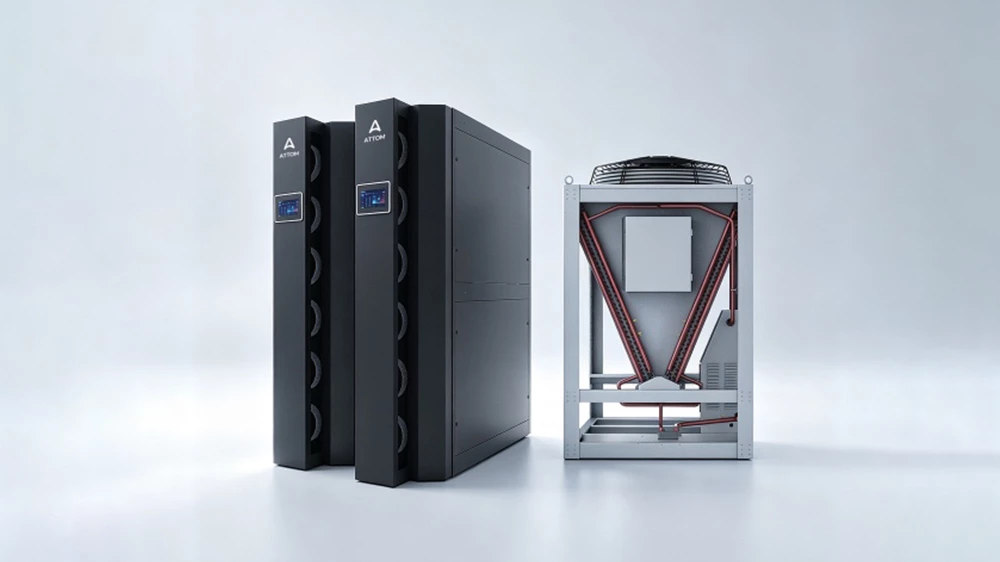
ATTOM’s SmoothAir Rear Door Heat Exchanger is designed for rack-level heat removal in high-density data center environments.
It provides a localized cooling approach that can be integrated into existing data center cooling infrastructure, making it suitable for both new deployments and retrofit applications.
Explore ATTOM SmoothAir Rear Door Heat Exchanger →
For projects where rack-level cooling is only one part of a broader liquid cooling strategy, SmoothAir can also be considered alongside ATTOM’s direct-to-chip and immersion cooling solutions.
Frequently Asked Questions
What is a Rear Door Heat Exchanger?
A Rear Door Heat Exchanger (RDHx) is a rack-level cooling system installed at the rear of a server cabinet. It removes heat from server exhaust air using a liquid cooling circuit before the heat enters the data center room.
Does RDHx cool the server directly?
No. RDHx removes heat from the server’s exhaust air rather than directly cooling the CPU or GPU. Direct-to-chip cooling uses cold plates to remove heat directly from high-power components.
Is RDHx a liquid cooling technology?
Yes. RDHx uses liquid to remove heat from server exhaust air, but the liquid remains within the heat exchanger and cooling loop rather than entering the server.
Is RDHx suitable for retrofits?
Yes. Retrofit applications are one of the strongest use cases for RDHx because it can increase rack cooling capacity without requiring extensive modifications to server hardware.
What is the difference between active and passive RDHx?
Passive RDHx relies primarily on existing server fans to move air through the heat exchanger. Active RDHx uses additional fans to increase airflow and support higher cooling loads.
Can RDHx replace CRAC or CRAH?
Usually not across an entire data center. RDHx is generally used together with room-level cooling, particularly when selected racks require additional cooling capacity.
Is RDHx suitable for AI data centers?
RDHx can support high-density AI racks and retrofit projects, particularly when operators want to increase cooling capacity without immediately converting servers to direct-to-chip or immersion cooling.
Conclusion
Rear Door Heat Exchangers provide a practical way to move heat removal closer to the server rack without requiring liquid to enter the IT equipment.
Their combination of localized cooling, retrofit potential, and compatibility with existing cooling infrastructure makes RDHx particularly useful for data centers that need to increase rack density gradually.
RDHx is not a replacement for every other cooling technology.
For moderate-to-high-density racks and retrofit projects, it can provide an effective transition between conventional air cooling and more advanced liquid cooling architectures. For extremely high-density AI and HPC workloads, direct-to-chip or immersion cooling may provide a more appropriate long-term solution.
The best RDHx deployment therefore starts with rack density, existing facility infrastructure, server architecture, and future cooling requirements—and then determines where rack-level heat removal provides the greatest value.