How AI Is Changing Traditional Data Centers
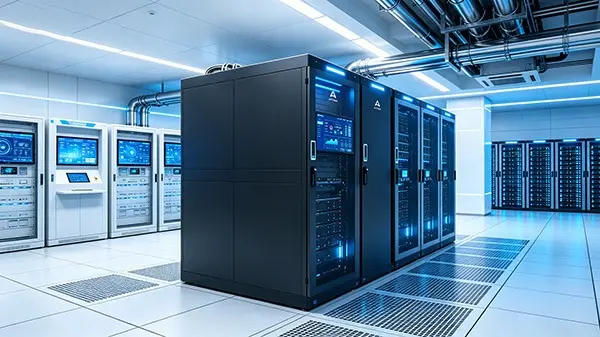
AI workloads are changing the way data centers are designed, operated and expanded. The most visible change is higher computing density, but the impact goes beyond GPU servers. Higher rack power affects power distribution, heat removal, airflow management, monitoring and the physical layout of the facility.
Traditional data centers were often designed around relatively predictable enterprise workloads. AI infrastructure introduces a different load profile. A small number of racks can now contain a large concentration of compute capacity, creating power and thermal requirements that existing infrastructure may not have been designed to handle.
For data center operators, the question is no longer only how much IT capacity a facility can provide. It is also how much power and heat each part of the facility can support.
AI Is Increasing Rack Power Density
One of the clearest differences between traditional and AI infrastructure is rack-level power density.Conventional enterprise servers distribute computing workloads across a larger number of racks. AI systems can concentrate GPUs or other accelerators into high-density clusters, increasing the electrical load of individual racks.This changes several infrastructure requirements at the same time.A higher rack load means more electrical power must reach the rack. That power is ultimately converted into heat, which must be removed continuously. As a result, rack power capacity and cooling capacity become closely connected.
The facility may still have sufficient total power capacity while individual areas lack the electrical infrastructure required for high-density AI deployment.
This is an important distinction when evaluating an existing data center. Facility-level capacity does not necessarily equal rack-level deployment capacity.
Cooling Becomes a More Significant Design Constraint
Traditional data centers commonly rely on room-level cooling systems to distribute conditioned air throughout the IT space. This approach can work effectively when rack densities remain within the design range of the cooling and airflow system.AI workloads can change that balance.As rack power increases, more heat must be removed from a smaller physical area. Increasing the capacity of room cooling equipment is one possible response, but it does not solve every thermal problem. Airflow volume, supply temperature, return paths and the distance between the cooling system and the heat source also affect the result.
For high-density deployments, cooling therefore needs to be considered as a distribution problem, not simply a capacity problem.
The relevant question becomes:How can cooling capacity be delivered to the location where the heat is generated and removed from that location efficiently?This is why row-level, rack-level and liquid cooling technologies are becoming increasingly relevant to AI infrastructure.
Airflow Management Faces New Constraints
AI workloads also change the importance of airflow management.In a conventional data center, hot aisle and cold aisle layouts help separate server intake air from exhaust air. Containment systems can further reduce the mixing of hot and cold air.These principles remain relevant for AI environments. However, higher rack densities leave less room for poor airflow design.A localized high-density rack can create a thermal condition that is very different from the average room temperature. Even when the overall room appears adequately cooled, individual racks can experience higher inlet temperatures if airflow distribution is not properly designed.
Several factors need to be considered together:
- Rack power density
- Server airflow requirements
- Supply airflow volume
- Hot-air return paths
- Cold-air distribution
- Containment strategy
- Cooling unit location
For this reason, AI deployment often requires more attention to rack-level thermal conditions rather than relying only on room-level measurements.
Power Distribution Must Be Reassessed
A traditional facility may have sufficient utility power and UPS capacity but still require modifications before high-density AI racks can be installed.The electrical path needs to be evaluated from the facility to the rack. Depending on the existing architecture, this can include:
- UPS capacity
- Power distribution units
- Rack PDUs
- Busway systems
- Distribution panels
- Branch circuits
- Redundancy requirements
- Rack-level power capacity
The key issue is not simply the total electrical capacity of the facility.A data center with sufficient overall IT power may still have insufficient power distribution capacity in the specific room, row or rack where an AI cluster is planned.
Existing Data Centers May Need Retrofitting
Not every AI deployment requires a new data center.
Existing facilities can potentially accommodate AI workloads, but the answer depends on the infrastructure already in place and the density of the planned deployment.
A retrofit assessment should consider at least five areas.
Power capacity
Can the existing electrical distribution deliver the required rack-level load? Are UPS and distribution systems appropriately sized?
Cooling capacity
Can the existing cooling system remove the additional heat without exceeding operating limits?
Airflow
Can conditioned air reach the high-density racks and can server exhaust air return to the cooling system without excessive mixing?
Physical space
Is there sufficient space for high-density racks, power distribution equipment, cooling equipment and associated infrastructure?
Liquid cooling readiness
If the planned AI hardware requires liquid cooling, can the facility accommodate the necessary cooling distribution infrastructure?
These questions should be answered before equipment is installed. Increasing server capacity first and addressing infrastructure limitations afterward can create avoidable deployment problems.
AI Does Not Automatically Mean Liquid Cooling
The growing use of liquid cooling does not mean every AI deployment requires it.The appropriate cooling architecture depends on rack density, server thermal design, facility conditions and the required cooling capacity.Air cooling remains practical for many workloads. As thermal density increases, however, the ability of air to transport heat becomes a more important engineering constraint.
Several approaches can be considered depending on the deployment:
- Room-based air cooling
- Row cooling
- Rack cooling
- Rear-door heat exchangers
- Direct-to-chip liquid cooling
- Immersion cooling
Each approach addresses heat removal differently.A rear-door heat exchanger, for example, places heat rejection closer to the rack exhaust path. Direct-to-chip cooling transfers heat from components through a liquid-cooled cold plate rather than relying entirely on room airflow. Immersion cooling takes a different approach by placing supported IT components in a dielectric cooling fluid.The selection should follow the actual thermal requirements of the workload rather than treating liquid cooling as a default requirement for AI.
Monitoring Needs to Become More Granular
Higher-density infrastructure also changes monitoring requirements.Traditional environmental monitoring may focus on room temperature, humidity and general equipment status. These measurements remain important, but high-density AI deployments can require more detailed visibility into power and thermal conditions.Operators may need to understand conditions at the rack or equipment level, particularly when a small number of high-density racks account for a significant portion of the facility’s IT load.
Relevant monitoring areas can include:
- Rack power
- Temperature
- Humidity
- Equipment status
- Cooling system status
- Environmental conditions
- Power distribution status
The purpose is not simply to collect more data. Monitoring should help operators identify whether infrastructure conditions remain within the limits required by the installed IT equipment.
AI Is Changing Data Center Deployment Models
Traditional projects often involve integrating racks, power, cooling, monitoring and other infrastructure on site. As infrastructure becomes more complex, factory-integrated and modular approaches can become useful alternatives for certain projects.
A modular or prefabricated approach can integrate multiple infrastructure components before delivery to the site. This can reduce the amount of system integration work that needs to be performed during the installation phase.The approach is particularly relevant when deployment needs to be repeated across multiple locations or when high-density infrastructure must be standardized.
It does not remove site constraints. Available power, network connectivity, space, environmental conditions and local installation requirements still determine whether a particular architecture is suitable.
What Should Operators Evaluate Before Adding AI Workloads?
Before introducing AI infrastructure into a traditional data center, operators should evaluate the facility from the rack outward rather than looking only at total building capacity.
| Infrastructure Area | Key Question |
|---|---|
| Rack power | Can the rack receive the required electrical load? |
| UPS | Is sufficient protected power available? |
| Distribution | Can power be delivered to the planned AI zone? |
| Cooling | Can the system remove the additional heat? |
| Airflow | Can cooling air reach the racks without excessive mixing? |
| Physical space | Is there enough room for IT and supporting infrastructure? |
| Liquid cooling | Can the facility support liquid cooling if required? |
| Monitoring | Is there sufficient visibility into power and thermal conditions? |
| Expansion | Can the infrastructure support future density increases? |
This assessment can reveal a common problem: the facility may have enough capacity in aggregate but not enough capacity at the point where AI hardware needs to operate.
The Shift From Capacity Planning to Density Planning
AI is not simply adding more servers to traditional data centers. It is changing the relationship between computing, power, cooling and physical infrastructure.
Traditional capacity planning often asks:How much IT capacity can the facility support?
AI infrastructure adds another question:How much computing density can each part of the facility physically, electrically and thermally support?
That distinction matters.A data center may have available floor space but insufficient power distribution. It may have sufficient power but insufficient cooling capacity. It may have adequate room cooling but lack the airflow architecture needed for high-density racks.
AI deployment therefore requires a more coordinated view of infrastructure.For operators working with existing facilities, the practical path is not necessarily to replace the entire data center. In many cases, the better approach is to identify the specific power, cooling and infrastructure constraints first, then determine whether targeted upgrades, higher-density cooling, liquid cooling or modular infrastructure can address them.